

-1.webp)
-1.webp)
-2.webp)














Why Live Rosin and Distillate Require Fundamentally Different Hardware
Understanding the Architectural Challenges of the Premium Extract Era
As the cannabis market enters the Premium Extract Era, a significant shift is underway. Consumers and brands are moving beyond THC potency to prioritize terpene profiles, full-spectrum integrity, and authentic sensory experiences.
However, most vaporization hardware remains rooted in the engineering logic of the early Distillate era. This has created a critical contradiction: Extracts have evolved, but hardware is stagnant. Live rosin and other terpene-rich extracts are less forgiving under generic high-power cartridge designs. They are easier to overheat, easier to mute, and more likely to create late-cycle performance problems when the hardware cannot keep oil flow and coil temperature stable. Distillate is more standardized and easier to run in cartridges, but once it is formulated for wick-fed devices, it can also become too mobile for hardware that is too open, too hot, or poorly sealed.
1. The Fundamental Duality of Extracts
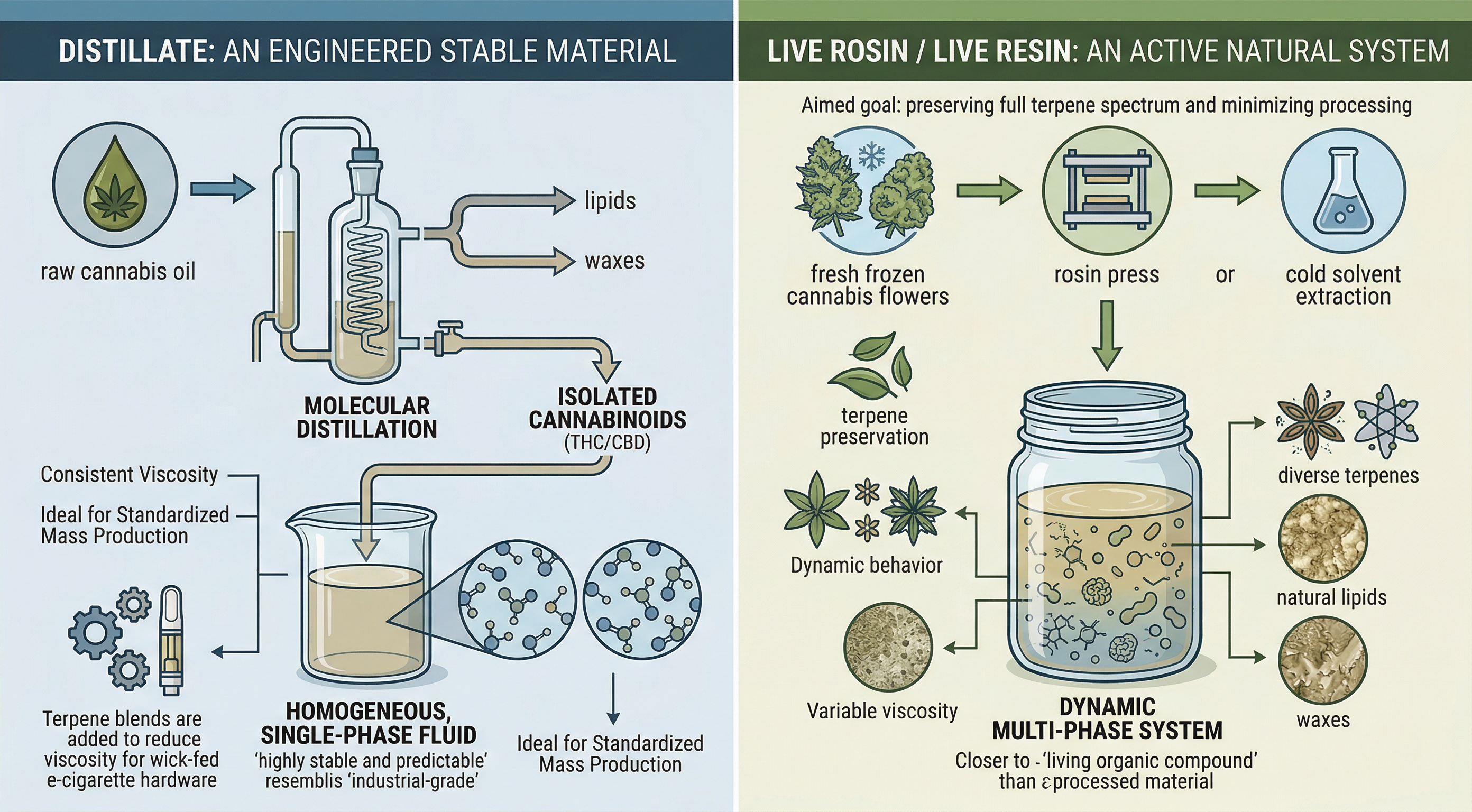
Distillate: An Engineered Stable Material
Distillate is refined through molecular distillation to isolate specific cannabinoids (THC or CBD) by removing lipids and waxes. The result is a homogeneous, single-phase fluid that is highly stable and predictable. Like an industrial-grade liquid, it features consistent viscosity and high heat tolerance, making it ideal for standardized mass production. In cartridge systems, terpene blends are often added not only for flavor, but also to reduce viscosity , and make the oil workable in wick-fed cannabis e-cigarette hardware.
Live Rosin / Live Resin: An Active Natural System
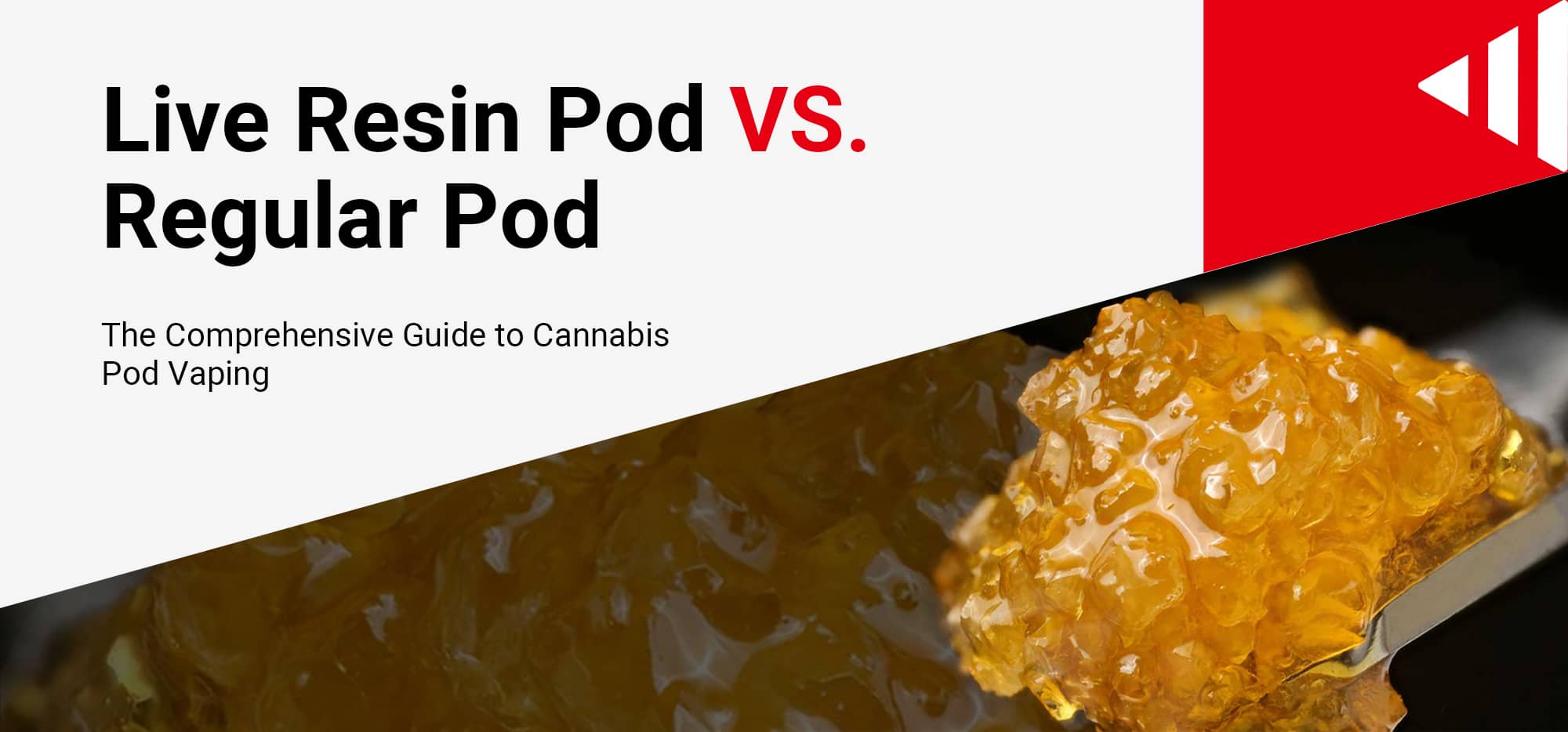
The goal of “Live” extracts is the opposite: to preserve the full terpene spectrum and minimize processing. Even after decarboxylation, these extracts remain a dynamic multi-phase system containing diverse terpenes, natural lipids, and waxes. Their behavior is closer to a living organic compound than a processed industrial material.
2. Winterization and the Value of “Retention”
-
- Live Rosin: Typically bypasses solvent-based winterization to honor the “solventless” philosophy. Brands prioritize authenticity over mechanical stability.
-
- Live Resin: May undergo partial winterization for compatibility, but it remains a non-homogeneous system.
-
- Distillate: The distillation process naturally completes dewaxing and separation.
The Verdict: Distillate’s stability comes from Separation; Live Extract’s value comes from Retention.
Why Traditional Architectures Fail
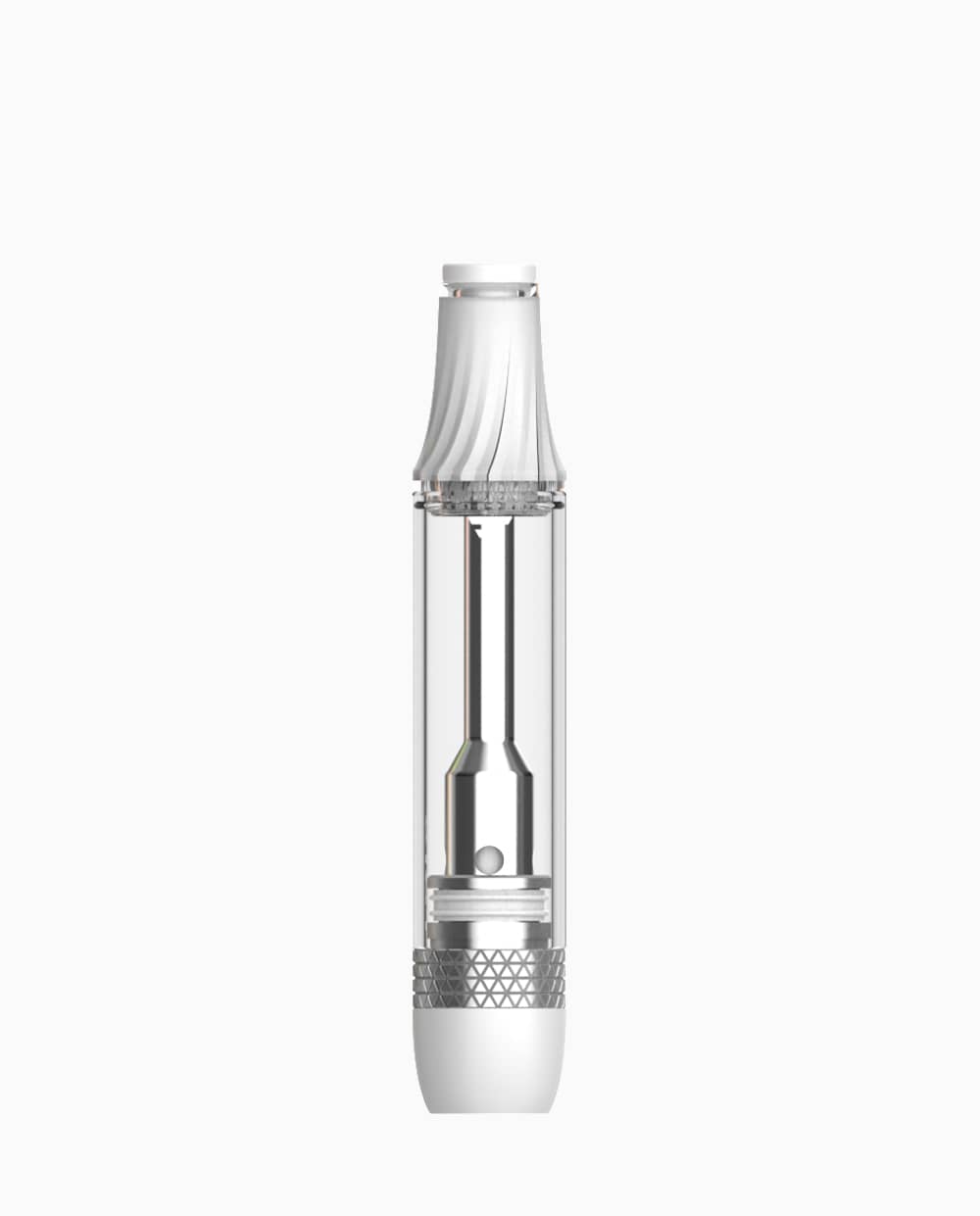
Most current hardware relies on the “Universal Atomizer” framework: a central metal post, polymer (PCTG) reservoirs, and fixed airflow paths. This system reveals four structural conflicts when paired with Live Extracts:
Thermal Mismanagement and the “Heat Bridge”
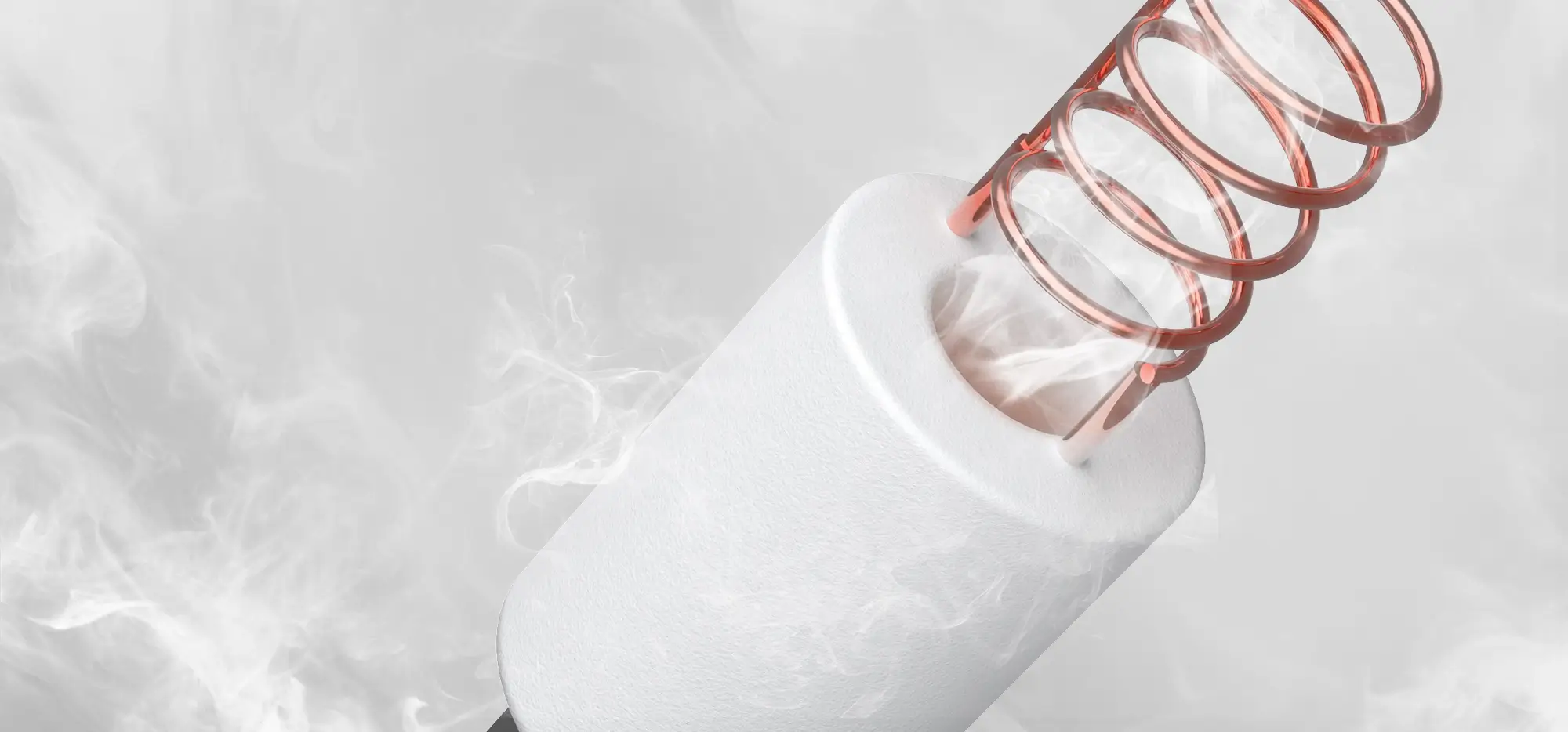
Traditional metal center-posts act as a structural Heat Bridge. After a session, residual heat continues to conduct into the reservoir, creating a “Slow-cooking Effect.” This causes sensitive extracts to oxidize, darken, and lose volatile terpenes prematurely.
Micro-wax Deposition and Pore Clogging
The issue isn’t ceramic quality, but design intent. While Distillate permeates ceramic pores evenly, the natural micro-waxes in Live Rosin gradually accumulate and clog the intake paths, leading to unstable wicking and a “dry-hit” experience in the latter half of the device’s life.
-
- Distillate (Homogeneous Viscosity): Consistent molecular structure leads to uniform heat response and predictable flow. If terpene loading, heat exposure, or cartridge geometry push the oil below the viscosity window the device was designed for, feed control gets harder and leakage risk rises.
-
- Live Extract (Structural Complexity): Different components react uniquely to heat. Light terpenes vaporize instantly, while heavier molecules linger and natural micro-waxes gradually precipitate. This heterogeneity causes viscosity to shift constantly during use. This explains why traditional hardware may perform well for the first few draws but suffers from clogging or flavor degradation later in the cycle.
Chemical Compatibility: The Solvent Challenge
Terpenes are potent natural solvents. This poses a rigorous challenge to material integrity:
-
- The Material Divide: Standard polymers can undergo microscopic chemical exchange when in contact with high-activity terpenes, potentially leading to flavor tainting or material degradation.
-
- High-Grade PCTG: Utilizing the highest tier of medical-grade, chemically-resistant PCTG can significantly mitigate these risks, providing the current benchmark for stability in mainstream premium markets.
-
- Absolute Inertness: For brands seeking “Zero-Interference,” the dense, non-porous structure of borosilicate glass offers a physical advantage, ensuring total purity in extreme terpene environments.
The “Voltage Overdrive” Conflict
Universal atomizers were engineered for the high-efficiency vaporization of Distillate, which requires high voltage for instant clouds.
-
- The Distillate Logic: Prioritizes volume and instant force.
-
- The Live Extract Conflict: Premium extracts have a wide boiling point spectrum (120°C – 220°C). Excessive voltage destroys delicate top-notes and causes localized carbonization of complex organic compounds, resulting in a burnt taste.
-
- Demand Mismatch: High-end users seek “Low-temp Vaping,” while legacy architecture remains stuck in the “Big Clouds” era.
The Ideal Vaporization Environment: 4 Core Conditions
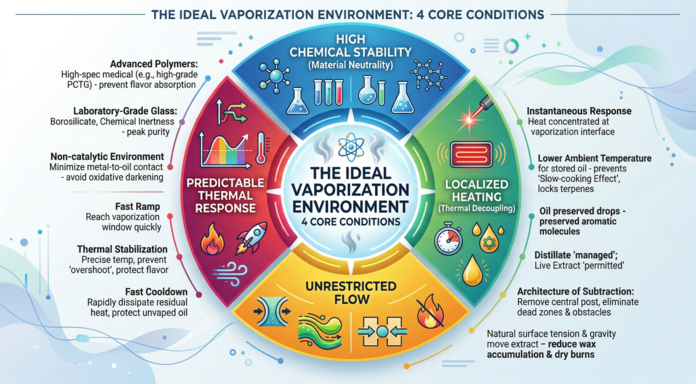
High Chemical Stability (Material Neutrality)
-
- Advanced Polymers: High-spec medical polymers (such as high-grade PCTG) provide excellent chemical resistance for most premium applications, preventing flavor absorption and ensuring material integrity during long-term contact.
-
- Laboratory-Grade Glass: For the pinnacle of purity, borosilicate glass provides total Chemical Inertness, ensuring the device does not participate in the flavor profile.
-
- Non-catalytic Environment: Hardware architecture should minimize metal-to-oil contact to avoid oxidative darkening catalyzed by metal surfaces, preserving the extract’s original color and bioactivity.
Localized Heating (Thermal Decoupling)
Ideal hardware achieves Thermal Decoupling between the heating element and the oil reservoir.
Instantaneous Response: Heat should be concentrated at the vaporization interface, leaving the stored oil at a lower ambient temperature. This prevents the “Slow-cooking Effect” and locks in the original terpene profile.
Unrestricted Flow
Distillate is “managed” by structure; Live Extract must be “permitted” by structure.
Architecture of Subtraction: Removing the central post eliminates “dead zones” and mechanical obstacles. Allowing the extract to move via natural surface tension and gravity reduces the risk of wax accumulation and dry burns.
Predictable Thermal Response
Premium extracts require a sophisticated three-stage thermal behavior:
-
- Fast Ramp: Reaching the vaporization window quickly.
-
- Thermal Stabilization: Maintaining a precise temperature to prevent “overshoot” which destroys flavor layers.
-
- Fast Cooldown: Rapidly dissipating residual heat to protect the integrity of the unvaped oil.
Conclusion: The Shift to Extract-Centric Architecture
The industry is moving away from asking “How do we make the oil fit the device?” to “How do we design the device to fit the oil?”
In the Premium Extract Era, hardware is no longer a mere container; it is the ultimate variable in brand asset protection. The difference between a “Universal” device and an Extract-Centric oneone is the difference between a generic delivery tool and a professional-grade curation vessel.
The final question for every brand remains: Does your hardware truly understand the value of the content it holds?