

-1.webp)
-1.webp)
-2.webp)































Does THC Make Your Eyes Red? What Science Says About Weed Eyes
Last Updated: Sep 14, 2026
Does THC make your eyes red? For many people, cannabis use can be followed by visible redness, dryness, or irritation, but these effects are not identical and do not have one universal cause. THC has the strongest evidence-based connection to cannabis-related eye changes. Dose, route of administration, smoke or aerosol exposure, contact lenses, the surrounding environment, and individual physiology may also affect what a person notices.
The phrase “weed eyes” usually describes more visible blood vessels across the white surface of the eye. Redness may occur with dryness or irritation, but one symptom does not automatically explain another. That distinction helps consumers avoid unsupported claims about terpenes, strain names, or hardware.
This article explains what research supports, where the evidence remains preliminary, and how to respond appropriately to uncomfortable symptoms. It is intended for adults as general education and should not be treated as a diagnosis or a substitute for professional eye care.
Why Does THC Make Your Eyes Red?
THC can affect ocular and cardiovascular physiology, but the common explanation that it simply lowers blood pressure and forces the eye’s capillaries to expand is incomplete. The visible red lines are conjunctival blood vessels near the eye’s surface. Changes in vascular tone may make those vessels appear more prominent, yet the precise response can differ with exposure, timing, and the person involved.
THC also interacts with the endocannabinoid system, including cannabinoid type 1 receptors, or CB1 receptors. Because these receptors occur in tissues associated with eye function, researchers examine several outcomes, including tearing and ocular surface responses. A change in one measurement does not explain every other symptom.
The most useful conclusion is that THC-related eye redness is a real but variable response. A person’s experience cannot be predicted from THC percentage alone because the label does not reveal the absorbed dose, inhalation pattern, previous exposure, or individual sensitivity. Red eyes also should not be used as a precise measure of intoxication or impairment.
Redness, Dryness, and Irritation Are Different Effects
Redness describes the appearance of surface blood vessels, while dryness concerns the quantity or stability of the tear film. Irritation describes how the eye feels. These effects can occur together, but a person may have bloodshot eyes without severe discomfort or feel dry and irritated without dramatic redness.
There is a plausible biological connection between THC and altered tearing. In a controlled animal study, THC reduced tearing in male mice through neuronal CB1 receptors associated with the lacrimal gland. The response differed in female mice, which shows why this finding cannot be converted into a universal prediction for people. The study also did not compare cannabis strains, terpene profiles, or vaporizer types.
Smoke or aerosol that reaches the ocular surface may create an additional irritation pathway. Heat, particles, airflow, and environmental dryness can affect comfort independently of THC’s systemic activity. This distinction matters in a recognizable situation: if symptoms become worse when exhaled material reaches the eyes, changing exposure conditions may be more relevant than searching for a different strain name.
What Determines How Noticeable Weed Eyes Become?
The severity of weed eyes is shaped by interacting variables rather than one ingredient. Two people using the same labeled product may report different experiences, and the same person may respond differently on separate occasions.
Total THC exposure is more informative than potency percentage considered alone. The amount consumed, delivery efficiency, inhalation pattern, and session length can change actual exposure. Previous cannabis use and individual sensitivity may further influence the response, so a higher label number does not translate into a fixed degree of redness.
Contact lenses, fatigue, existing dry-eye symptoms, allergies, medications, low humidity, and airflow can also change how the ocular surface looks or feels. These variables help explain why a simple product-to-outcome rule is unreliable.
Do Pinene and Myrcene Change THC Red Eyes?
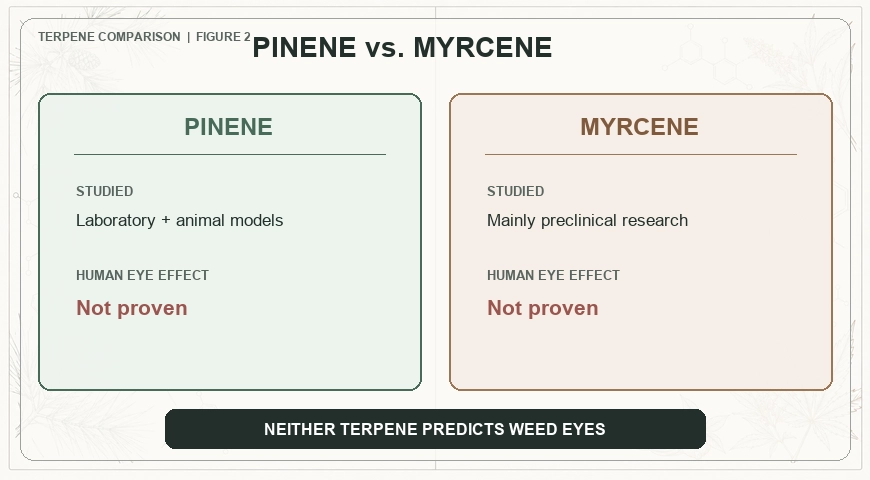
Current evidence does not establish that pinene prevents THC red eyes or that myrcene makes them worse. Both compounds are aromatic terpenes found in cannabis and other plants, and both have been examined in laboratory or preclinical research. However, research on a molecule’s general biological activity is not equivalent to a controlled human study of cannabis-related eye redness.
What Pinene Research Can Support
Alpha-pinene and beta-pinene contribute pine-like aromatic notes to some cannabis products. Laboratory research has examined alpha-pinene as an acetylcholinesterase inhibitor, but that work did not test cannabis consumers, tear production, or visible eye redness. It cannot support the claim that a pinene-rich product protects the tear film or keeps the eyes clear.
Vascular findings require the same care. Research found that alpha-pinene and related metabolites produced relaxation in isolated mouse blood vessel models. Those vessels were not part of the human ocular surface, and the exposure conditions did not reproduce normal cannabis use. The result does not demonstrate that pinene reduces or increases weed eyes.
What Myrcene Research Can Support
Myrcene is associated with earthy or herbal aromas and appears in many cannabis chemovars. It is often described online as sedating, dehydrating, or capable of helping THC cross the blood-brain barrier. The strongest versions of those claims go beyond the available human evidence, especially when they are used to predict a specific ocular response.
Evidence for terpene-driven cannabis outcomes remains limited. A systematic entourage-effect review concluded that proposed synergistic or additive enhancement remains unproven. No evidence reviewed for this article shows that myrcene directly suppresses human tear production, doubles visible redness, or causes longer-lasting eye discomfort after cannabis use.
Why Controlled Human Evidence Is Still Needed
A credible pinene-versus-myrcene comparison requires a controlled study rather than a simulated model. Essential records include ethics and consent procedures, formulation composition, dose delivery, randomization, environmental controls, raw measurements, adverse events, and statistical methods.
Matching labeled THC and terpene percentages would not isolate the terpene automatically. Formulation, aerosol delivery, baseline tear status, humidity, previous exposure, and individual metabolism could affect the result. A small group can generate large-looking but uncertain differences.
Measurement tools also need validation. Schirmer readings may vary within the same person, while ocular photography requires standardized lighting, timing, a validated redness scale, and masked assessment. Without these controls, precise claims about faster clearing or percentage reductions are not established findings.
Can a COA or Strain Name Predict Red Eyes?
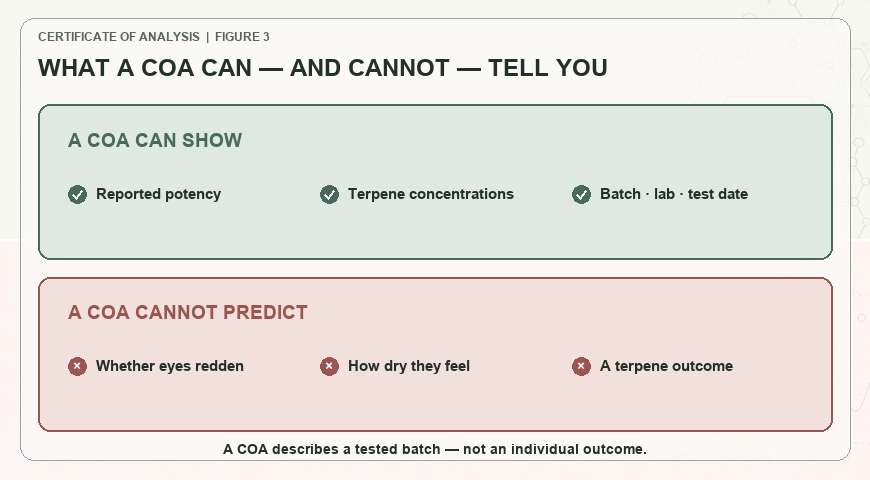
A certificate of analysis can describe a tested batch, but it cannot predict whether an individual will develop red or dry eyes. A COA may report cannabinoid potency, detected terpene concentrations, the laboratory, and the test date. Those are composition records rather than clinical outcome measurements.
Batch-level chemistry is usually more informative than relying on a familiar strain name. Cannabis sold under the same cultivar name may vary because of genetics, cultivation, harvest timing, processing, formulation, and storage. A name such as Blue Dream or Jack Herer therefore should not be treated as a reliable promise of a particular terpene ratio or ocular response.
Consumers and budtenders can use a COA descriptively: confirm the tested batch, review the reported THC and terpene values, and compare those records with prior personal observations. They should not convert “high pinene” into “less redness” or “high myrcene” into “more dryness.” Chemistry data and individual outcomes answer different questions.
Does Vaporizer Hardware Prevent Weed Eyes?
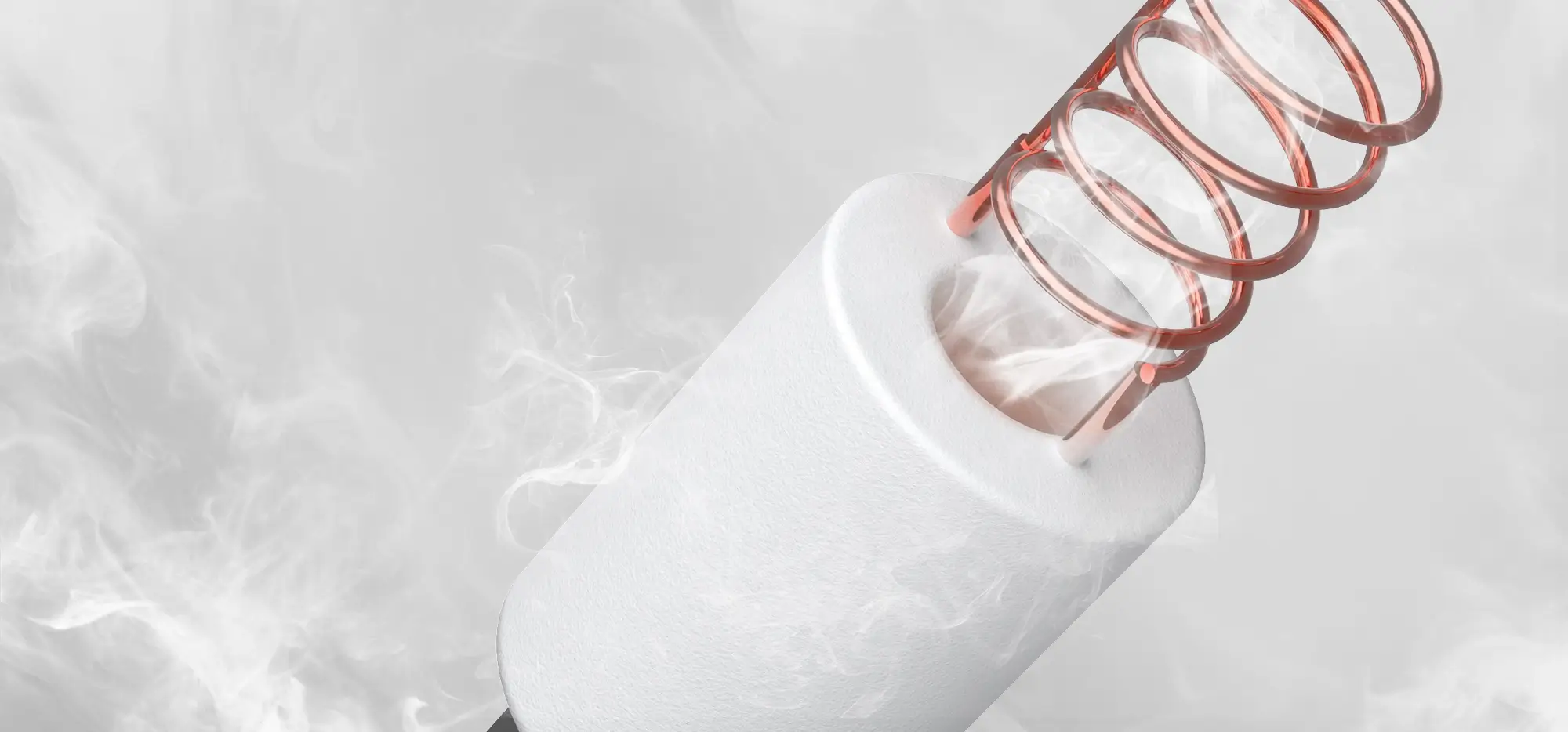
Vaporizer hardware is not a proven prevention method for THC-related eye redness. It can influence heating and aerosol delivery, but coil design, power, airflow, formulation, and user behavior interact. These engineering variables do not establish an ocular outcome.
Temperature deserves particular care. A device setting does not necessarily equal the temperature throughout the formulation, and temperature alone does not reveal the composition of the aerosol.
Manufacturers can test temperature behavior, aerosol composition, formulation compatibility, and sensory observations under disclosed conditions. Claims about eye comfort require separate product-specific human evidence.
What Should You Do When Your Eyes Feel Red or Irritated?
The appropriate response is to reduce exposure and pay attention to the type and severity of the symptoms. Move away from smoke or aerosol, avoid rubbing the eyes, and remove contact lenses if irritation develops. Do not place cannabis extracts, CBD preparations, essential oils, or products not labeled for ophthalmic use into the eyes.
-
- Stop the exposure if redness or discomfort is increasing.
-
- Note whether smoke, aerosol, contact lenses, or dry airflow reached the eyes.
-
- Avoid driving or other safety-sensitive activity while impaired.
-
- Seek professional advice for pain, vision changes, injury, severe light sensitivity, discharge, swelling, or persistent symptoms.
Short-lived redness in both eyes without pain may improve as the exposure passes, but appearance and duration cannot diagnose the cause. Eye symptoms can arise from allergy, infection, injury, contact-lens problems, or other conditions unrelated to cannabis. Concerning or worsening symptoms should not be masked by repeatedly trying different products.
Conclusion
THC has the clearest connection to weed eyes, but the response remains variable and cannot be calculated from a label alone. Redness, dryness, and irritation describe different outcomes, while total exposure, delivery route, environmental conditions, contact lenses, and personal physiology may influence what a user experiences.
Pinene and myrcene remain secondary research questions rather than reliable shopping tools. A COA can document batch composition, and vaporizer testing can document engineering behavior, but neither can guarantee an individual eye response. Clear distinctions between established evidence, preclinical findings, and unanswered questions make cannabis education more useful—and more trustworthy.
21+ ONLY
Disclaimer
This content is for informational purposes only and does not constitute medical or legal advice. Please consult a licensed healthcare provider before using cannabis products. Comply with your state’s regulations.
This content is intended for audiences 21 years and older, as required by U.S. law.
Cannabis regulations vary by state. Please verify the legal status of products in your area before purchase.