
-1.webp)
-1.webp)
-2.webp)





















How Much THC Is in a Pre-Roll? How to Read the Label and Calculate Total THC
Last Updated: Sep 14, 2026
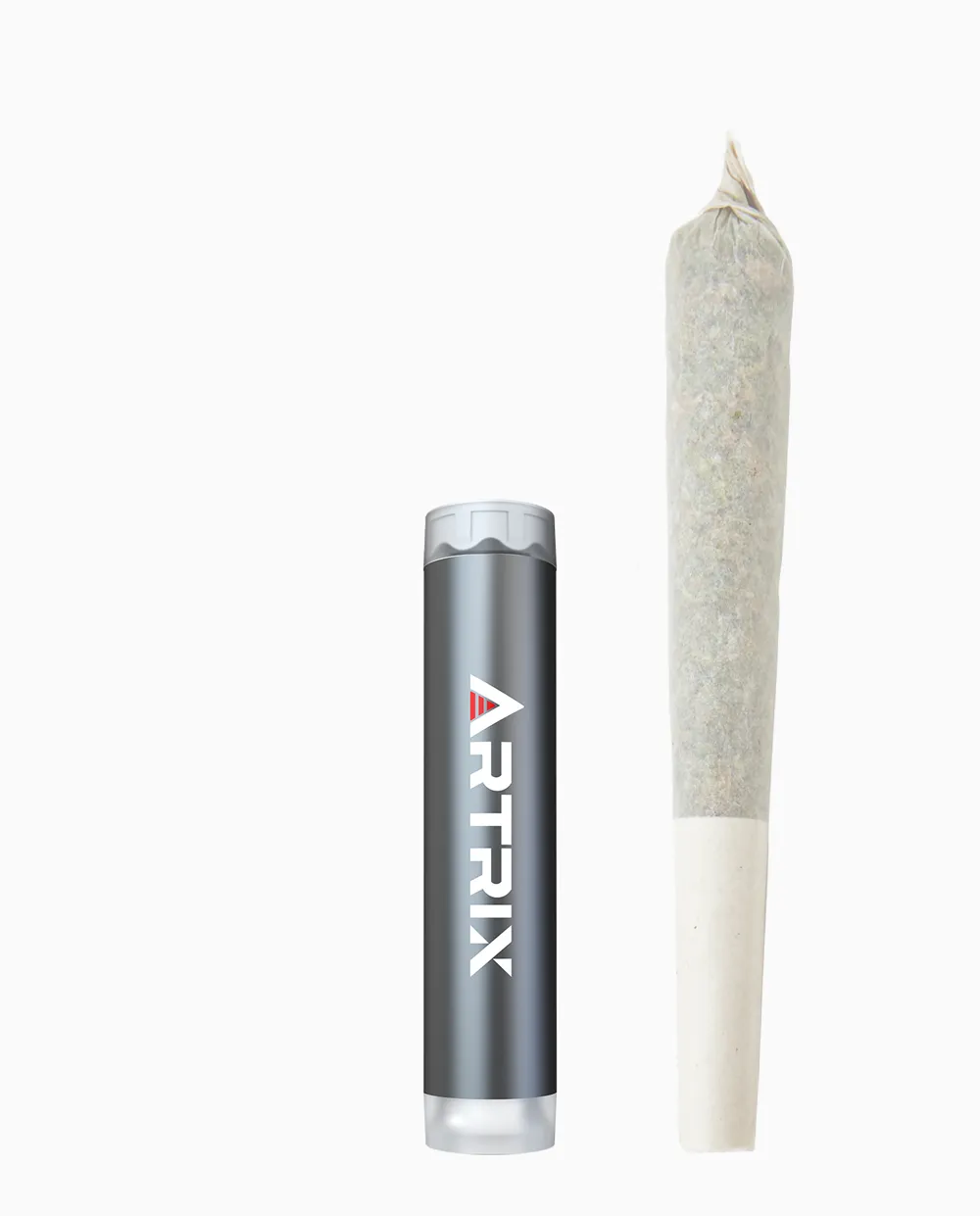
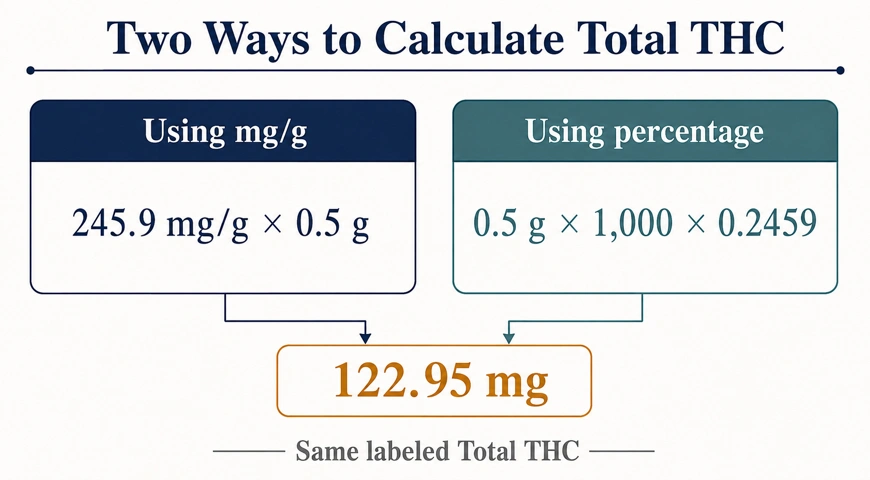
A pre-roll’s labeled total THC depends on two numbers: the weight of the joint and the Total THC concentration on the package. Multiply the joint weight in grams by the Total THC value in milligrams per gram. If the label uses a percentage, multiply the joint weight by 1,000 and then by the percentage written as a decimal.
For example, a 0.5 g pre-roll at 24.59% total THC is calculated like this: 0.5 x 1,000 x 0.2459 = 122.95 mg total THC. This result describes the labeled total THC in the material. It is not a measurement of how much THC a person will inhale, absorb, or feel.
Quick Answer: How to Calculate THC in One Pre-Roll
The most important point is that THC percentage alone is incomplete. A 0.5 g joint at 25% THC contains about half as many total milligrams as a 1 g joint at the same potency. Weight and percentage always need to be read together.
| What the label shows | Calculation | Example for one 0.5 g pre-roll |
|---|---|---|
| Total THC in mg/g | mg/g × joint weight in grams | 245.9 mg/g × 0.5 g = 122.95 mg |
| Total THC as a percentage | grams × 1,000 × decimal percentage | 0.5 × 1,000 × 0.2459 = 122.95 mg |
| Total THC per unit | Use the stated per-unit amount | No weight conversion is needed if the label clearly gives a value for each joint |
Before calculating, confirm whether the displayed weight applies to one pre-roll or the whole package. A three-pack containing 1.5 g in total may consist of three 0.5 g joints. Using 1.5 g in the per-joint calculation would triple the answer by mistake.
How to Read mg/g, Percentage, and Per-Unit Values
Milligrams per gram and percentage are two ways to express concentration. A label showing 245.9 mg/g is equivalent to 24.59% by weight because 1% of one gram equals 10 mg. The conversion is therefore straightforward: divide mg/g by 10 to obtain a percentage, or multiply the percentage by 10 to obtain mg/g.
Canadian requirements provide a useful example of how these labels work. For dried cannabis in discrete units intended for inhalation, the current rules require the number of units, the weight of each unit, and the Total THC concentration that the cannabis could yield after accounting for potential THCA conversion. Health Canada also explains that a concentration such as 180 mg/g can be multiplied by the product weight to calculate the total labeled amount. See the cannabis label guide and section 124.1 of the Cannabis Regulations.
THC vs THCA: Why Some Labels Show Two Different Numbers
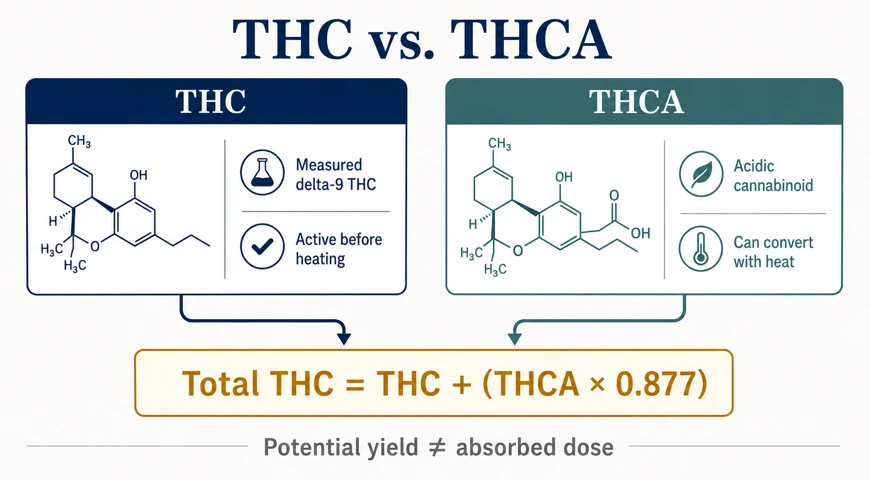
A pre-roll label may show both THC-related values and total THC because raw cannabis often contains THCA, the acidic cannabinoid that can convert into THC when heated. The smaller THC figure generally describes the delta-9 THC measured before use, while Total THC accounts for the potential contribution from THCA.
A common technical formula is: total THC = delta-9 THC + THCA x 0.877. The 0.877 factor adjusts for the chemical weight change that happens during THCA conversion. The factor is a molecular-mass correction used in cannabinoid analysis; it does not mean that smoking converts and delivers every available milligram to the user.
For label comparison, Total THC is usually the relevant value when the package presents both THC and Total THC. For a 0.5 g joint labeled at 245.9 mg/g Total THC, multiply 245.9 by 0.5. The result is 122.95 mg of labeled total THC per pre-roll, regardless of whether the package contains one joint or several identical joints.
A Three-Pack Example, Step by Step
A Reddit user described a common problem: a package contained three 0.5 g pre-rolls, but its cannabinoid panel showed a smaller THC number and a larger Total THC figure, such as 245.9 mg/g or 24.59%. The two values appeared contradictory until the user separated measured THC from Total THC and checked whether the concentration applied per gram or per joint.
-
- Find the net weight of each pre-roll.
-
- Find the total THC figure, usually shown as a percentage or mg/g.
-
- If using mg/g, multiply that number by the joint weight in grams.
-
- If using percentage, multiply grams x 1,000 x THC percentage.
-
- Describe the answer as labeled total THC, not as an inhaled or absorbed dose.
For the beginner 3-pack example, the math is straightforward: 245.9 mg/g x 0.5 g = 122.95 mg total THC per joint. If that person smokes half the joint, the labeled THC in the smoked portion is about 61.48 mg before real-world loss.
Why Labeled THC Is Not the Same as THC You Actually Inhale
Labeled THC tells you what the product can yield, not exactly what reaches your bloodstream. When a pre-roll burns, some cannabinoids are lost through heat, sidestream smoke, ash, incomplete combustion, and exhaled smoke. This is why a joint with 122.95 mg labeled total THC should not be treated as a precise consumed dose.
Four different quantities are involved: the THC listed on the label, the THC contained in the portion that is burned, the THC present in inhaled smoke, and the THC ultimately absorbed by the body. These quantities are related, but they are not interchangeable. Puff size, smoking pace, combustion behavior, and product construction can change exposure, while tolerance and individual response mainly change how the exposure feels.
A better way to think about the number is as a comparison tool. It helps you compare one pre-roll against another, estimate relative strength, and understand whether a product is higher or lower in labeled potency. It should not be used as a perfect prediction of personal effect.
How to Compare Regular and Infused Pre-Rolls
Compare pre-rolls by format, weight, and labeled Total THC rather than relying on the largest percentage alone. A regular flower pre-roll contains ground cannabis flower, while an infused pre-roll also contains a concentrate such as hash, kief, distillate, or resin. Because the formulations differ, two products of equal weight can have very different cannabinoid concentrations.
For infused pre-rolls, cannabinoid distribution can matter as much as total potency. If concentrate is distributed unevenly, different portions may not burn or feel identical. This is a reasonable formulation concern, but a specific claim about uniformity, clogging, burn rate, or THC delivery requires testing of the finished product.
-
- Confirm the weight of each joint, not only the package weight.
-
- Use Total THC when the label separately lists THC and Total THC.
-
- Check whether the product is flower-only or infused.
-
- Review the package date, lot information, and storage instructions.
Lower-Risk Guidance for New Consumers
A new consumer should not choose a pre-roll by matching a potency band to a self-described tolerance level. High THC can increase the likelihood of unwanted effects, and experience does not make a particular potency universally appropriate. Health Canada advises new consumers to consider products with less than 100 mg/g, or 10%, THC and an equal or higher amount of CBD, while recognizing that local rules and available products differ.
Inhaled cannabis can begin to produce effects within seconds to minutes, but the full effects may take 10 to 30 minutes to appear. Consuming more during that interval can increase the risk of adverse effects. Review the official consumer guidance for inhaled cannabis.
Do not try to intensify absorption through deep inhalation or breath-holding. These practices disproportionately increase respiratory exposure to toxic material, according to Canada’s lower-risk cannabis use guidelines. Avoid driving or operating machinery while impaired, keep cannabis away from children and pets, and follow local age and possession laws.
Frequently Asked Questions
How many milligrams of THC are in a 0.5 g pre-roll?
Multiply the Total THC concentration in mg/g by 0.5. At 200 mg/g, the pre-roll contains 100 mg of labeled total THC. At 245.9 mg/g, it contains 122.95 mg.
Is 20% THC the same as 200 mg/g?
Yes, when both values describe the same cannabinoid measure by weight. One percent equals 10 mg/g, so 20% equals 200 mg/g.
Does smoking half a joint mean absorbing half its THC?
No. Half the joint contains approximately half the labeled THC, but combustion and inhalation prevent the label from functioning as an absorbed-dose measurement.
Conclusion: Use the Label for Calculation, Not Dose Prediction
For consumers, the best habit is to start low, read total THC carefully, and remember that labeled milligrams are not the same as inhaled milligrams. When health, medication, pregnancy, or another personal risk factor is involved, seek advice from a qualified healthcare professional rather than relying on a package calculation.
21+ ONLY
Disclaimer
This content is for informational purposes only and does not constitute medical or legal advice. Please consult a licensed healthcare provider before using cannabis products. Comply with your state’s regulations.
This content is intended for audiences 21 years and older, as required by U.S. law.
Cannabis regulations vary by state. Please verify the legal status of products in your area before purchase.