
-1.webp)
-1.webp)
-2.webp)








Is THCa Flower Legal in the United States? Federal Rules, State Risk, and the 2026 Change
Last Updated: September 14, 2026
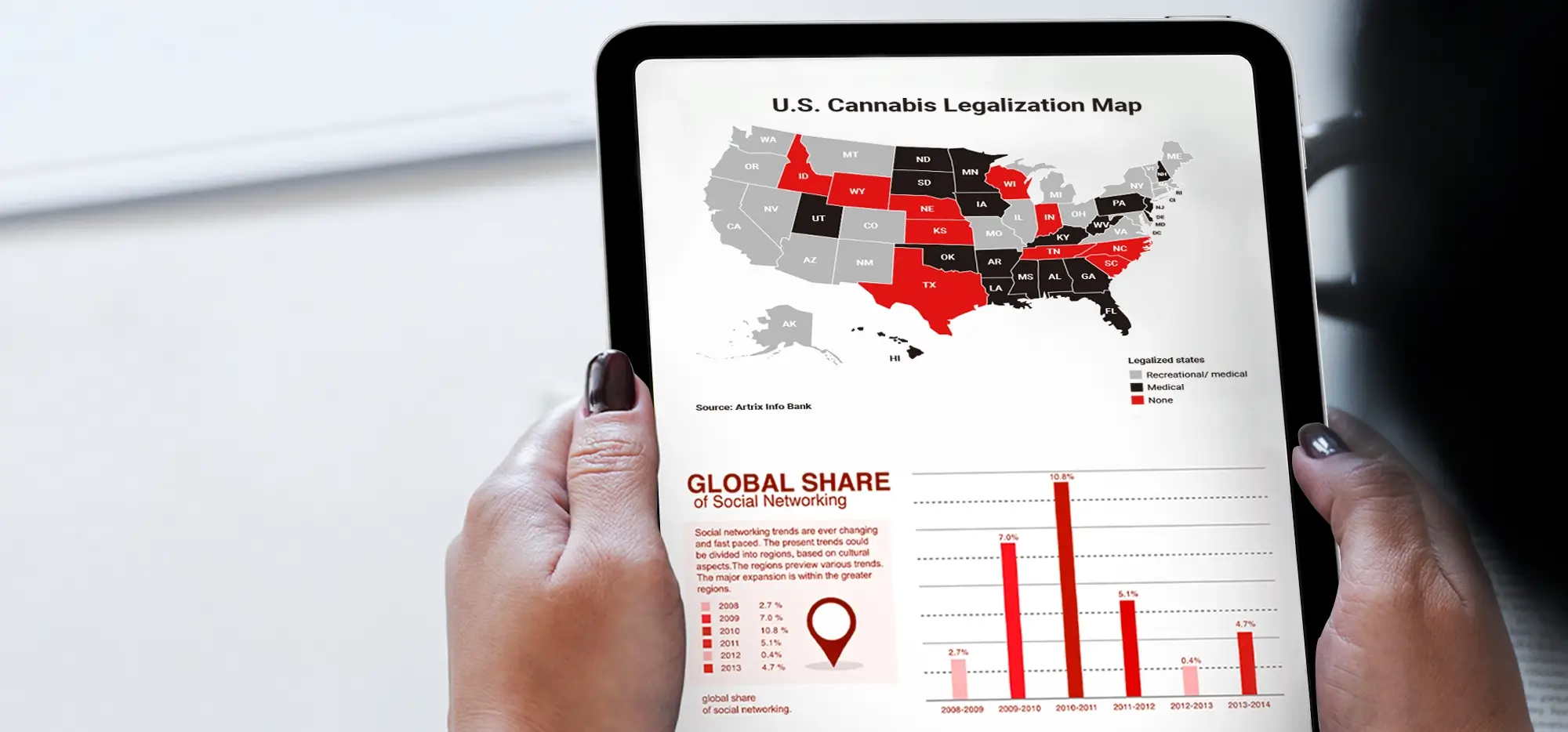
THCa flower is not uniformly legal across the United States. A THCa flower can look compliant on an online product page and still create legal risk once it is shipped, possessed, heated, or tested in another state. The federal hemp framework has historically focused on delta-9 THC, but USDA hemp testing also accounts for THCA conversion when determining total THC, and states may add their own rules for hemp products, smokable flower, retail sale, and possession.
A product may be marketed as hemp because its delta-9 THC level is low before heating. But THCa can convert into delta-9 THC when heated, and some legal or testing frameworks focus on total THC rather than only the raw delta-9 number.
For a useful answer, a buyer must identify four things: the date on which the rule applies, the product form, the exact batch test, and the law of the destination state. A seller accepting an order is not a substitute for those checks.
Two Federal Time Periods Matter in 2026
Before November 12, 2026
The federal framework in effect before November 12, 2026, retains the 2018 Farm Bill definition based on no more than 0.3% delta-9 THC on a dry-weight basis. However, federal production testing already measures total available THC by accounting for potential THCA conversion. That distinction helps explain why a retail label and a production compliance test can appear to emphasize different numbers.
Effective November 12, 2026
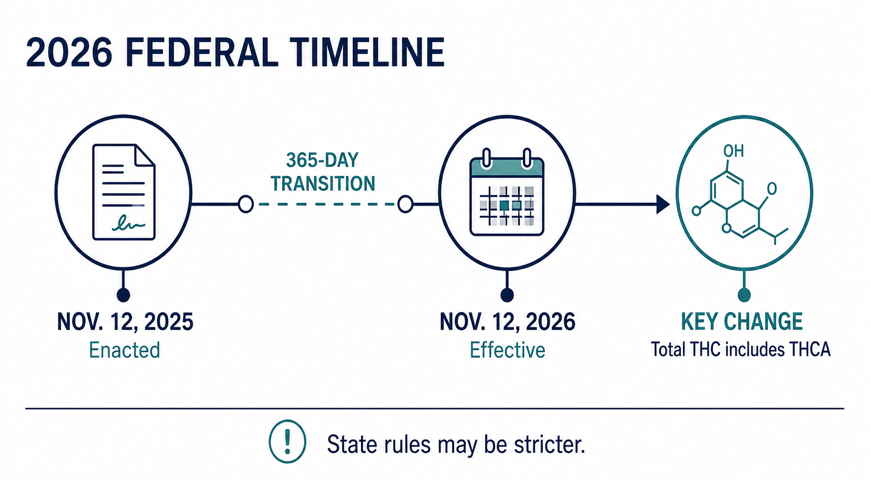
The 2026 federal change should be dated precisely. Public Law 119-37 was enacted on November 12, 2025, and Section 781 states that the hemp-definition amendments become effective 365 days after enactment. The amended definition uses total tetrahydrocannabinols, including THCA, and excludes final hemp-derived cannabinoid products with more than 0.4 milligrams combined total per container of total tetrahydrocannabinols and similar-effect cannabinoids.
As of this article’s September 7, 2026 review date, that amendment has been enacted but has not yet reached its scheduled effective date. Readers should not describe the new definition as already operative, and they should not assume that the transition overrides stricter state rules.
THCa Is Not the Same Question as Delta-9 THC
THCa matters because it can become delta-9 THC when heated. In raw cannabis flower, much of the potential intoxicating effect may be tied to acidic cannabinoids such as THCa rather than only the already-active delta-9 THC number shown on a simple label. When flower is smoked, vaped, or decarboxylated for edibles, heat changes the chemical picture.
The most important COA issue is the difference between delta-9 THC and total THC. USDA says hemp testing must consider the potential conversion of THCA into THC, and describes total THC as the value after decarboxylation or after applying a conversion factor. For licensed hemp production, USDA gives the formula as THCA × 0.877 plus delta-9 THC, with the result reported on a dry-weight basis.
That USDA calculation has a defined scope: it supports crop sampling and production compliance under USDA, state, or tribal hemp plans. It should not be presented as a universal rule that automatically determines whether a finished retail product is lawful to sell, ship, or possess in every state.
The State-Line Scenario: Why Risk Changes on the Route
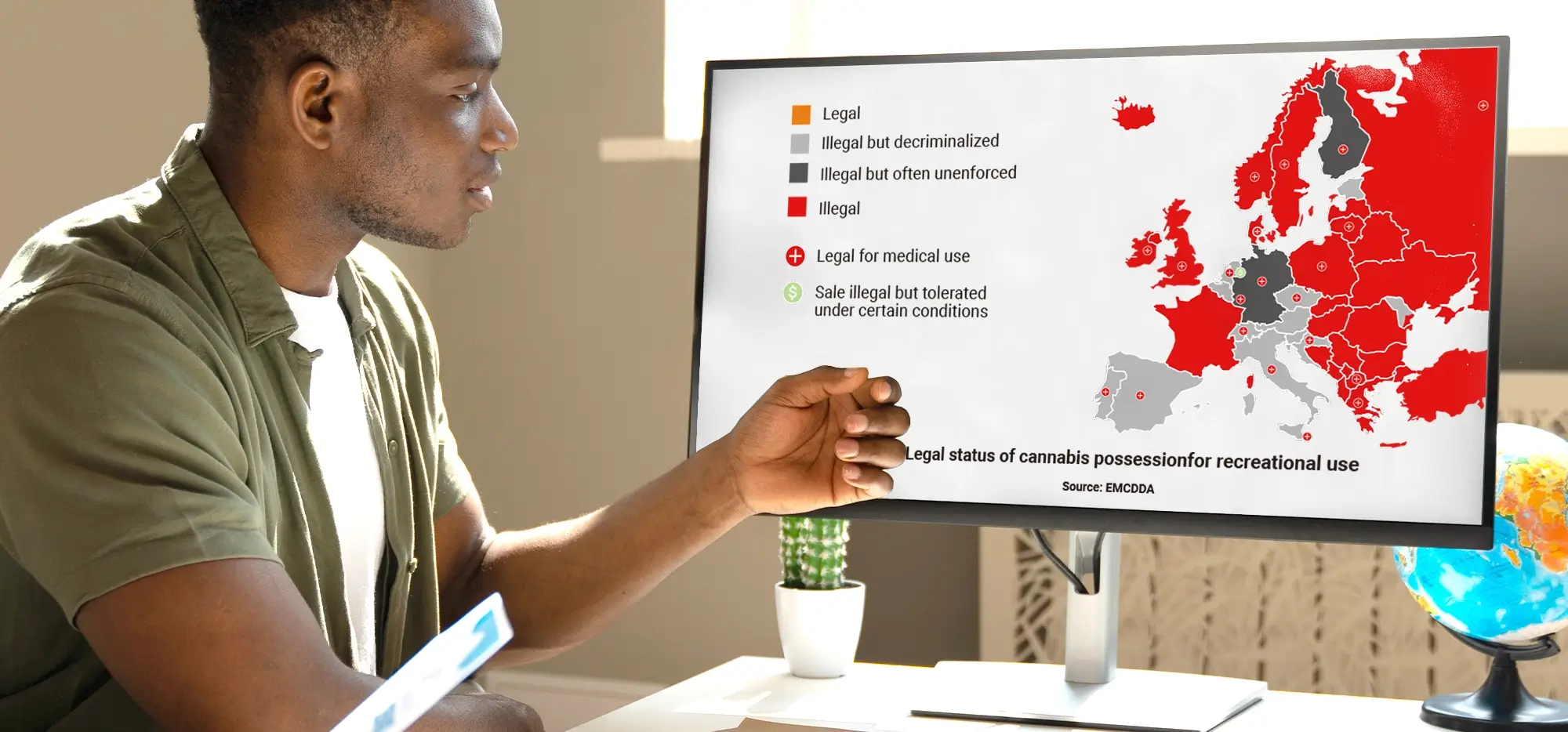
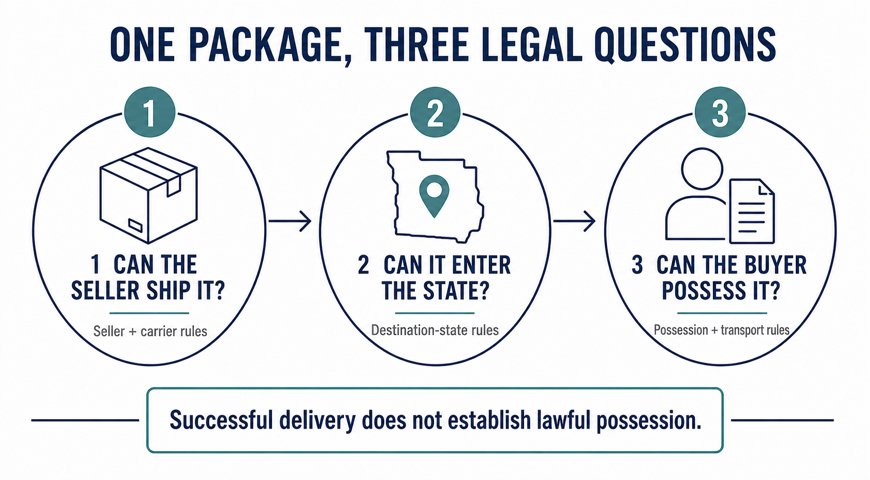
Imagine a buyer orders THCa flower from an online seller. The product page says it is hemp-derived and includes a COA showing low delta-9 THC. The seller ships it to a state where cannabis remains restricted, then the buyer drives with it through another state with different hemp rules. The same jar now sits inside several overlapping questions: Was it lawfully produced? Is it legal to ship there? Is possession protected? Does the state use total THC? Is smokable hemp treated differently? Would a field officer recognize it as hemp without lab testing?
Mailability is not the same as legal safety. The current USPS rule permits qualifying hemp products in domestic mail only when the mailer complies with applicable federal, state, and local laws and retains compliance records for at least three years. USPS updated its hemp-mailing requirements in 2021. That makes the destination state and product documentation central to any THCa shipping discussion.
The safest wording is not “THCa is legal in the United States.” A more accurate framing is: THCa flower may be sold as hemp in some contexts, but the legal risk depends on product testing, product form, destination state, state hemp rules, and enforcement practices.
Product Form Changes the Legal Question
For readers comparing hemp-derived formats, the distinction between THCa flower and delta-8 products is especially important. Delta-8 products are often discussed separately because many concentrated products are manufactured from hemp-derived CBD rather than simply harvested as flower.
| Product form | Main verification question | Why it matters in practice |
|---|---|---|
| THCa flower | Does the state regulate total THC, smokable hemp, or cannabis possession? | The material may be difficult to distinguish visually from marijuana without laboratory testing. |
| Gummies and other ingestibles | Do serving, package, ingredient, food, and age rules apply? | A weight-based hemp claim does not resolve every finished-food requirement. |
| Vape products | How does the state regulate the cannabinoid formulation and inhalable product? | Oil composition, labeling, and device documentation address different parts of the buyer’s evaluation. |
The 2018 Farm Bill preserved FDA authority over products regulated under the Federal Food, Drug, and Cosmetic Act. As a result, meeting a federal hemp definition does not remove other applicable federal product requirements. FDA’s cannabis regulation FAQ explains this separate layer of authority.
How to Check Your State Before Ordering
A useful state-law check should produce a dated, product-specific answer. Start with the state legislature, agriculture department, health department, cannabis regulator, or attorney general. Record the product form, THC definition, regulated activity, effective date, and any pending change. Retailer policies may flag an issue, but they do not replace current state authority.
What Buyers Should Check Before Ordering THCa Flower
Before ordering THCa flower, buyers should verify the product, the seller, the destination state, and the route. That may sound excessive, but it is the only way to avoid treating a marketing phrase as legal advice.
-
- Confirm whether the purchase would occur before or after November 12, 2026, and identify the federal definition applicable on that date.
-
- Check the COA for delta-9 THC, THCa, total THC, testing date, and lab name.
-
- Confirm whether the COA matches the exact product batch being sold.
-
- Review the seller’s shipping exclusions and age-gating policies.
-
- Look up the destination state’s rules on smokable hemp and intoxicating hemp products.
-
- Check whether the state uses total THC or another standard that accounts for THCa conversion.
-
- Do not assume possession is protected just because an online sale was accepted.
-
- Recheck the rules before carrying the product into another state, because the law governing the route may differ from the law at the original destination.
Frequently Asked Questions
Does a COA make THCa flower legal?
No. A COA documents test results for a sample. Legality also depends on the applicable date, jurisdiction, product form, regulated activity, and whether the report matches the actual batch.
Can THCa flower be mailed through USPS?
USPS permits qualifying hemp products in domestic mail when the mailer satisfies the applicable laws and recordkeeping conditions. Meeting USPS mailability conditions does not independently settle whether the recipient may lawfully possess the product.
Is THCa flower the same as delta-8?
No. THCa is an acidic cannabinoid naturally present in cannabis and can convert to delta-9 THC through heat. Concentrated delta-8 products are commonly discussed as a separate category because production route, formulation, and state treatment may differ.
Bottom Line: The Risk Is Not Only in the Flower
The risk is not only in the THCa flower itself. It is in the gap between the product’s online label, the COA, the shipping destination, the state’s hemp rules, and how the product may be interpreted after it is heated or tested. That is why a THCa flower can look legal online and become risky after one state line.
The most reliable decision framework is therefore: applicable date, exact product and batch evidence, destination-state rule, and intended activity. If any one of those elements is missing, the article, product page, or shipping confirmation has not yet answered the buyer’s legal question.
21+ ONLY
Disclaimer
This article is for education only and is not legal advice. Cannabis and hemp rules are age-restricted, state-specific, and changing quickly. Adult consumers should verify current state law before buying, shipping, carrying, or using any THCa product.