


-1.webp)
-1.webp)
-2.webp)






















Missouri Cannabis Vape Market Trends 2026: What Brands Need to Know About the Next Stage of Product Evolution
This analysis was conducted by Artrix Market Intelligence using market data covering Missouri’s licensed cannabis vape market. The dataset includes disposable and cartridge products observed during the study period and is analyzed by device format, oil category, capacity, and product status.
Market-share figures presented in this article are estimates based on the available dataset unless otherwise stated. New-product analysis includes SKUs first observed within the defined launch window. Records were standardized to reduce duplicate listings and inconsistent retailer naming. Because retail availability and data coverage may change over time, the findings should be interpreted as directional market indicators rather than a complete representation of all Missouri cannabis vape transactions.
Data coverage: Q1 2025–Q2 2026
Analysis completed: [August 2026]
Source: Artrix Market Intelligence
Missouri’s Vape Market Is Moving Toward a More Segmented Product Landscape
Missouri’s cannabis vape market is entering a new stage of product development.
As the adult-use market continues to evolve, consumers have access to a wider range of vape products across different formats, oil categories, capacity options, and flavor experiences. However, the market is not simply moving from one dominant product type to another. Instead, different product directions are developing around different market needs, creating a more segmented product landscape.
This shift can already be observed through current market signals. Distillate remains the foundation of Missouri’s disposable vape market, representing approximately 76%–81% of the disposable oil category. At the same time, Live Resin maintains a stable premium position at approximately 11%–14%, while Liquid Diamonds increased from approximately 0.2% to 4.5%. Meanwhile, 2g products increased from approximately 6%–10% of unit volume, showing that capacity is becoming another important factor shaping product development.
Together, these trends indicate that Missouri’s vape market is moving beyond a single mainstream product structure. Instead, different product categories are beginning to serve different product positions, from accessible everyday products to premium extract-focused offerings and larger-capacity formats.
For brands evaluating future vape products in Missouri, the key consideration is no longer only what products are currently performing well, but how market structure is evolving and where new product opportunities are emerging.
AIO Growth Is Expanding the Mainstream Vape Market
One of the clearest changes in Missouri’s vape market is happening at the product-format level.
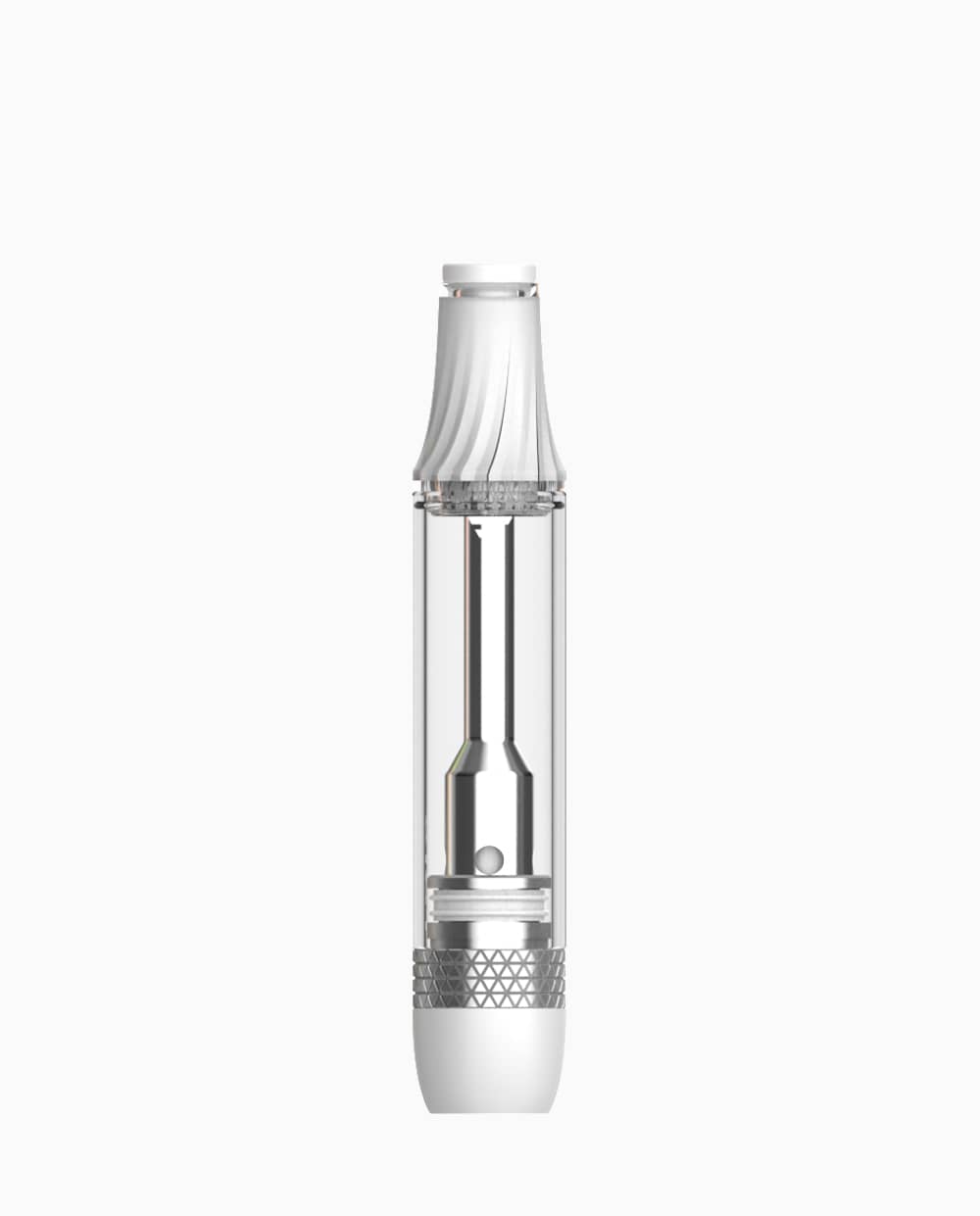
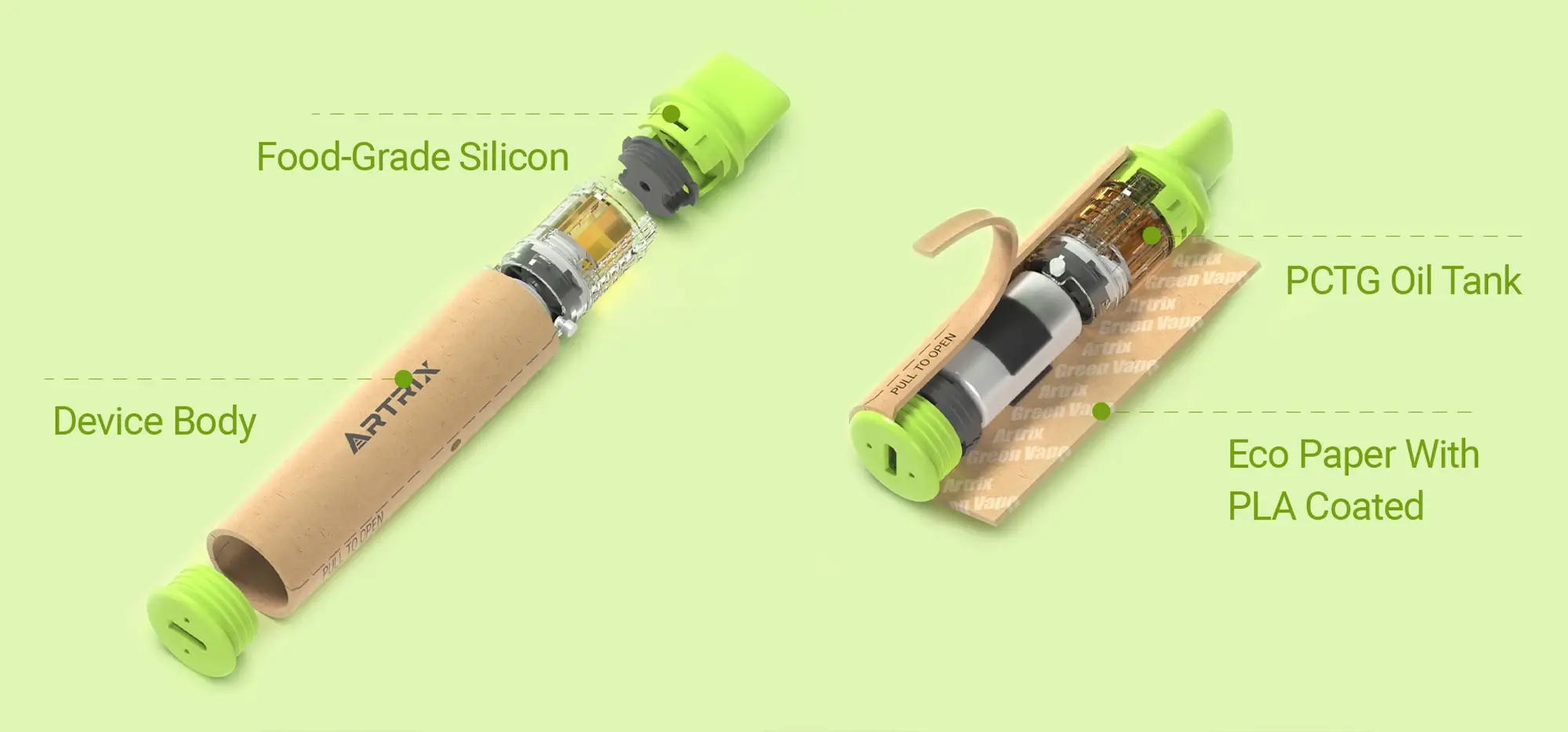
Traditional 510 cartridge systems have long been an important part of cannabis vaping. In this model, the battery and cartridge are separate components, requiring consumers to understand device compatibility and usage steps. While this format remains established, the market is increasingly showing demand for more integrated product experiences.
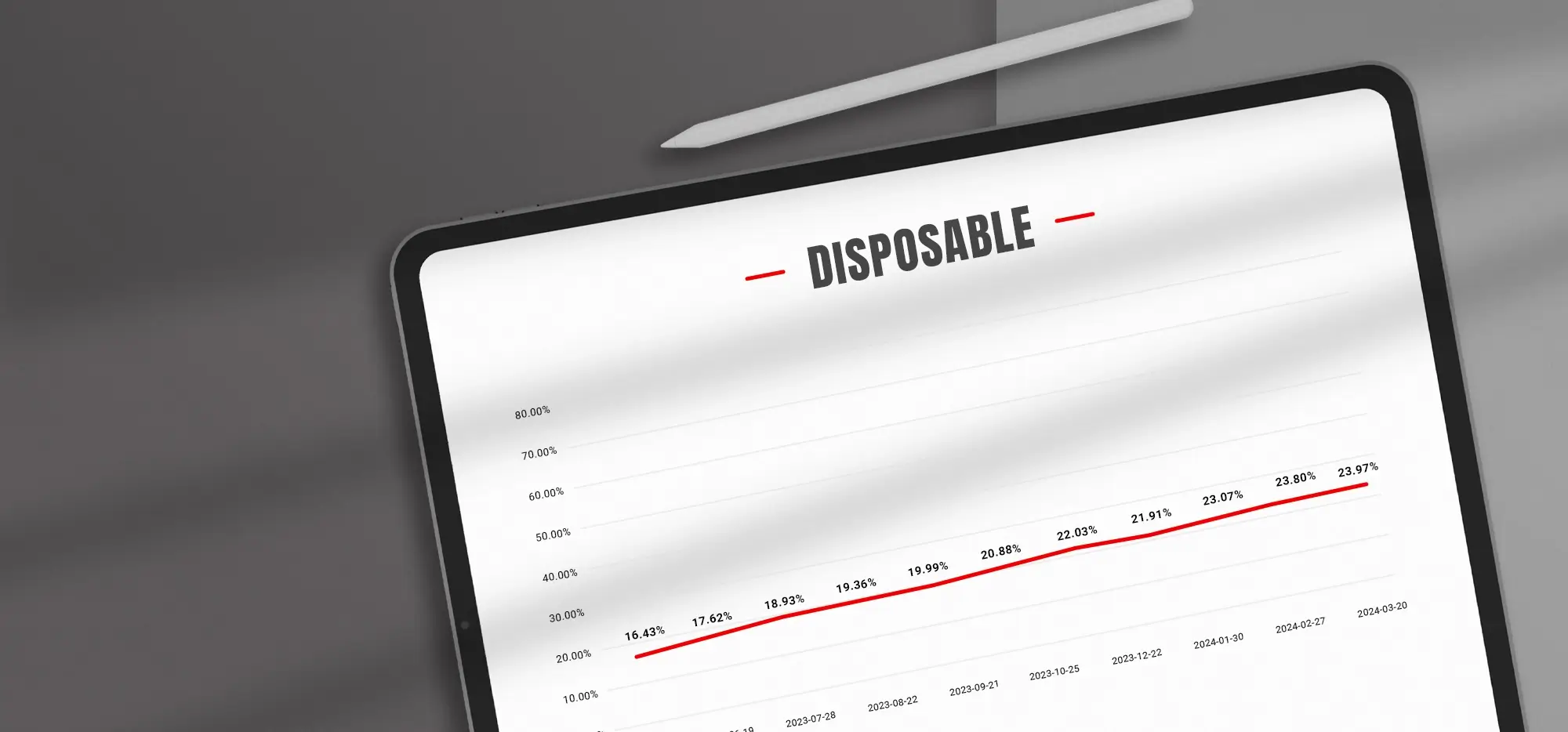
From Q1 2025 to Q2 2026, All-in-One Disposable sales increased by approximately 30%, while 510 cartridge products remained relatively stable.
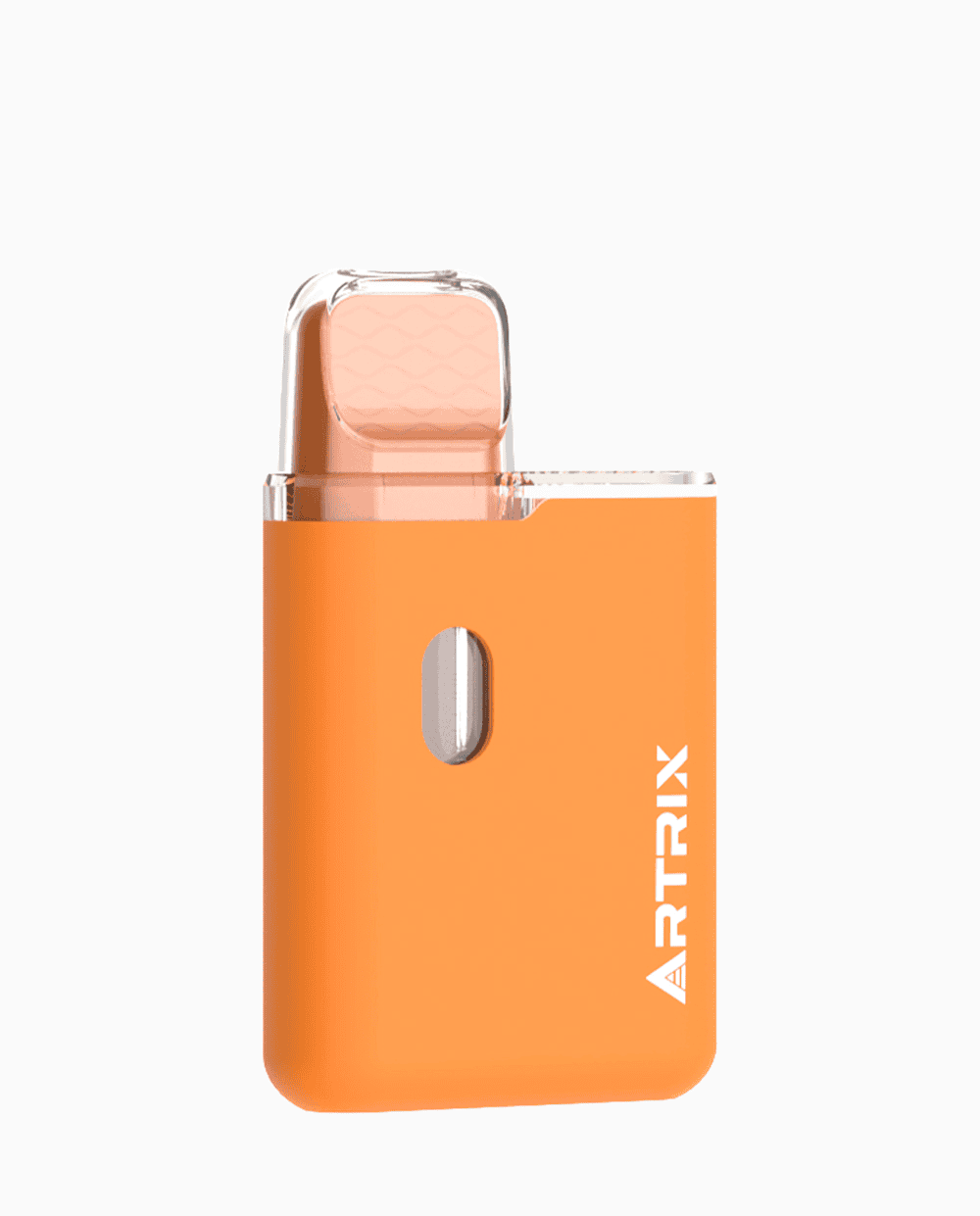
This does not indicate a simple replacement of 510 by AIO. Instead, the market appears to be developing two parallel product paths. Traditional cartridge systems continue to serve existing usage scenarios, while AIO products provide a more complete experience by integrating the battery system, oil chamber, and heating system into one device.
The value of AIO is therefore not only the hardware structure itself. By reducing the need for consumers to select separate components or understand complex device settings, AIO products lower the barrier to entry and create a more consistent user experience through pre-configured heating profiles and device parameters.
As more of the consumer experience becomes integrated into the device, hardware is becoming less about individual components and more about delivering a complete product experience.
Distillate Still Drives Volume, While Product Innovation Moves Toward Premium Extracts
Although product formats are evolving, Missouri’s mainstream vape market remains largely built around Distillate.
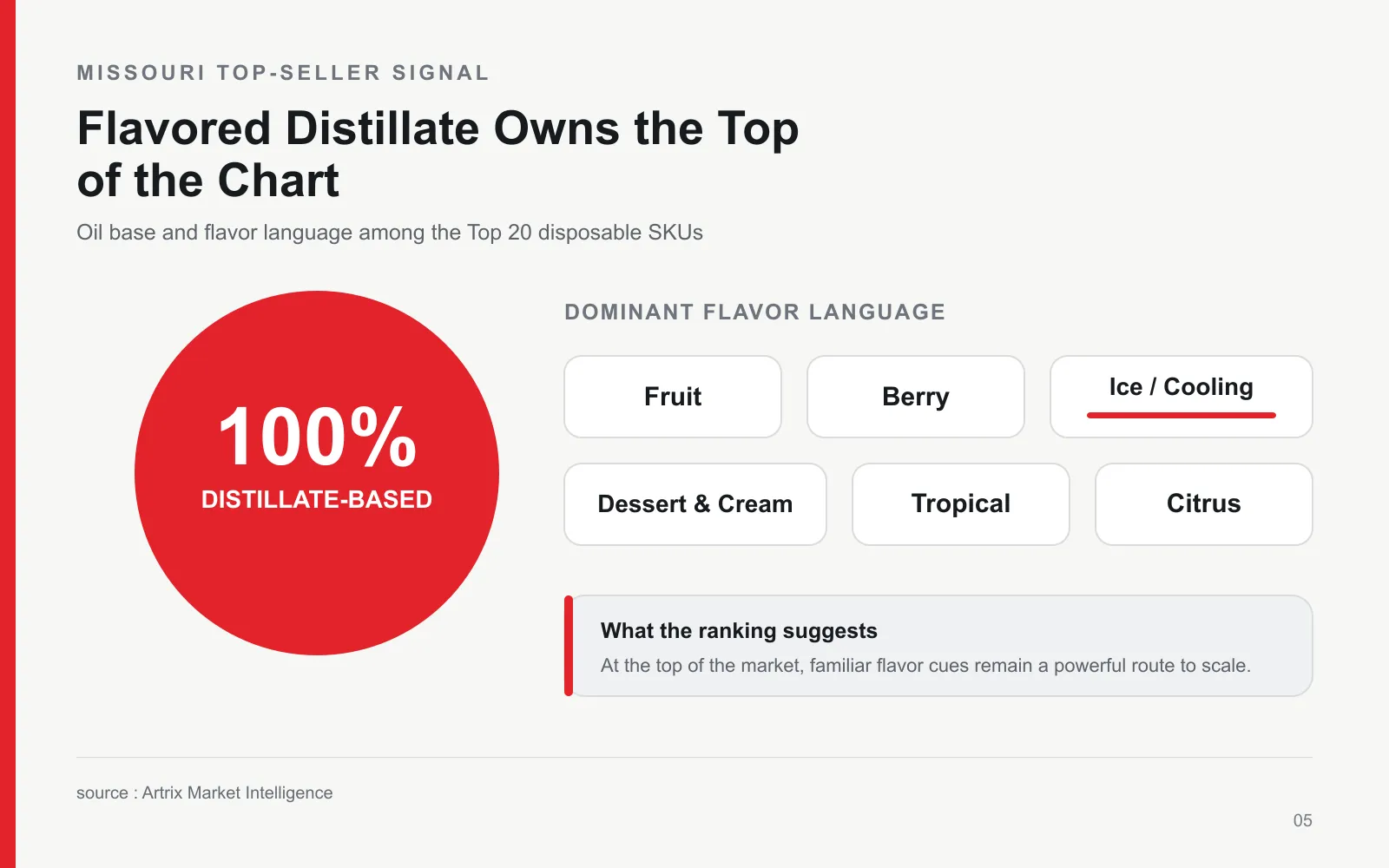
Market data shows that Distillate represents approximately 76%–81% of Missouri’s disposable oil category, and all Top 20 disposable SKUs are Distillate-based products. This demonstrates that mainstream demand continues to be centered around familiar, accessible product experiences.
However, sales structure does not fully represent where product innovation is moving.
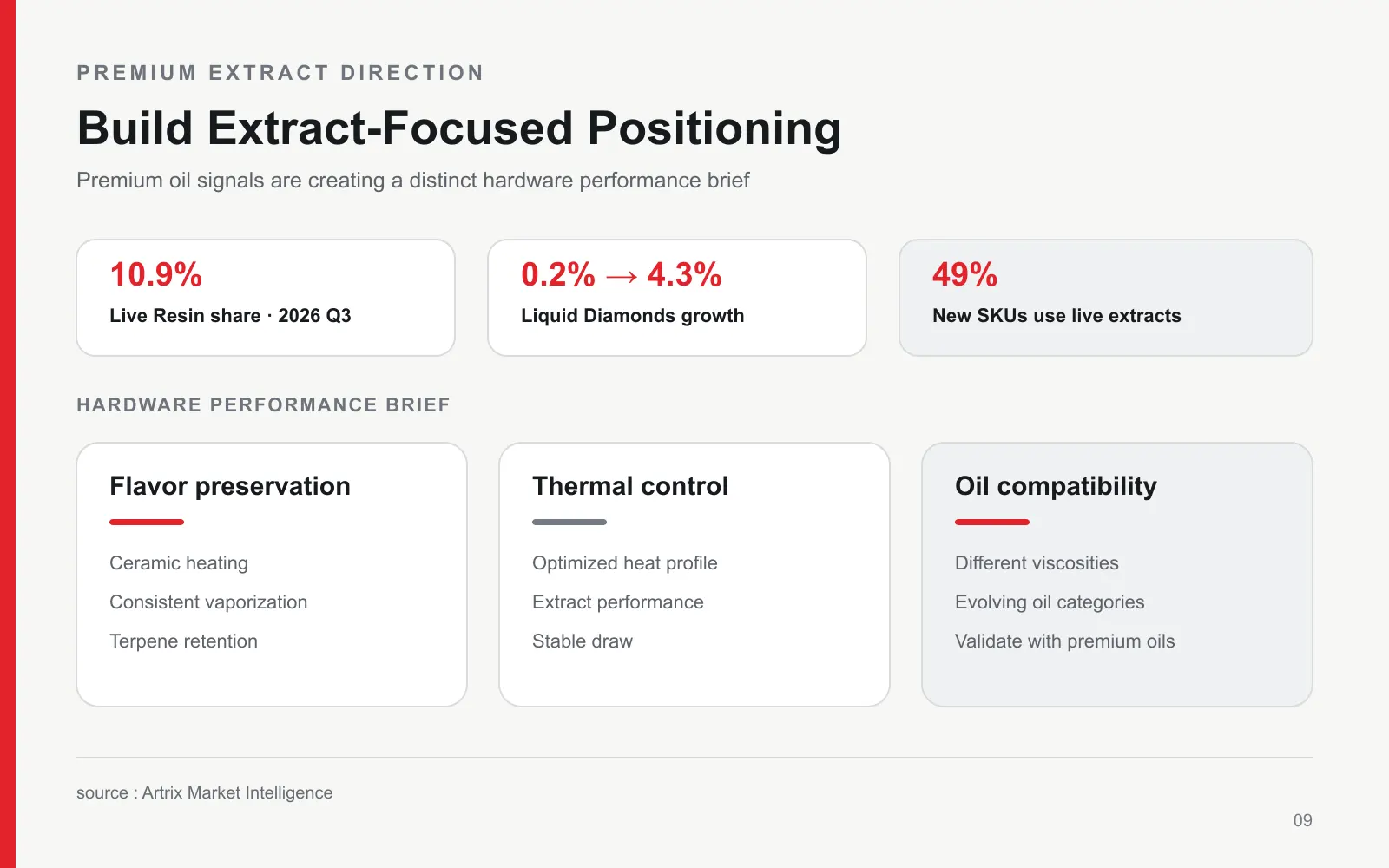
Recent product launch activity shows a different direction. Among newly launched disposable products, Distillate accounts for approximately 38% of new SKUs, while Live Resin (29%) and Live Rosin (20%) together represent 49% of new product launches. Diamonds account for approximately 10%.
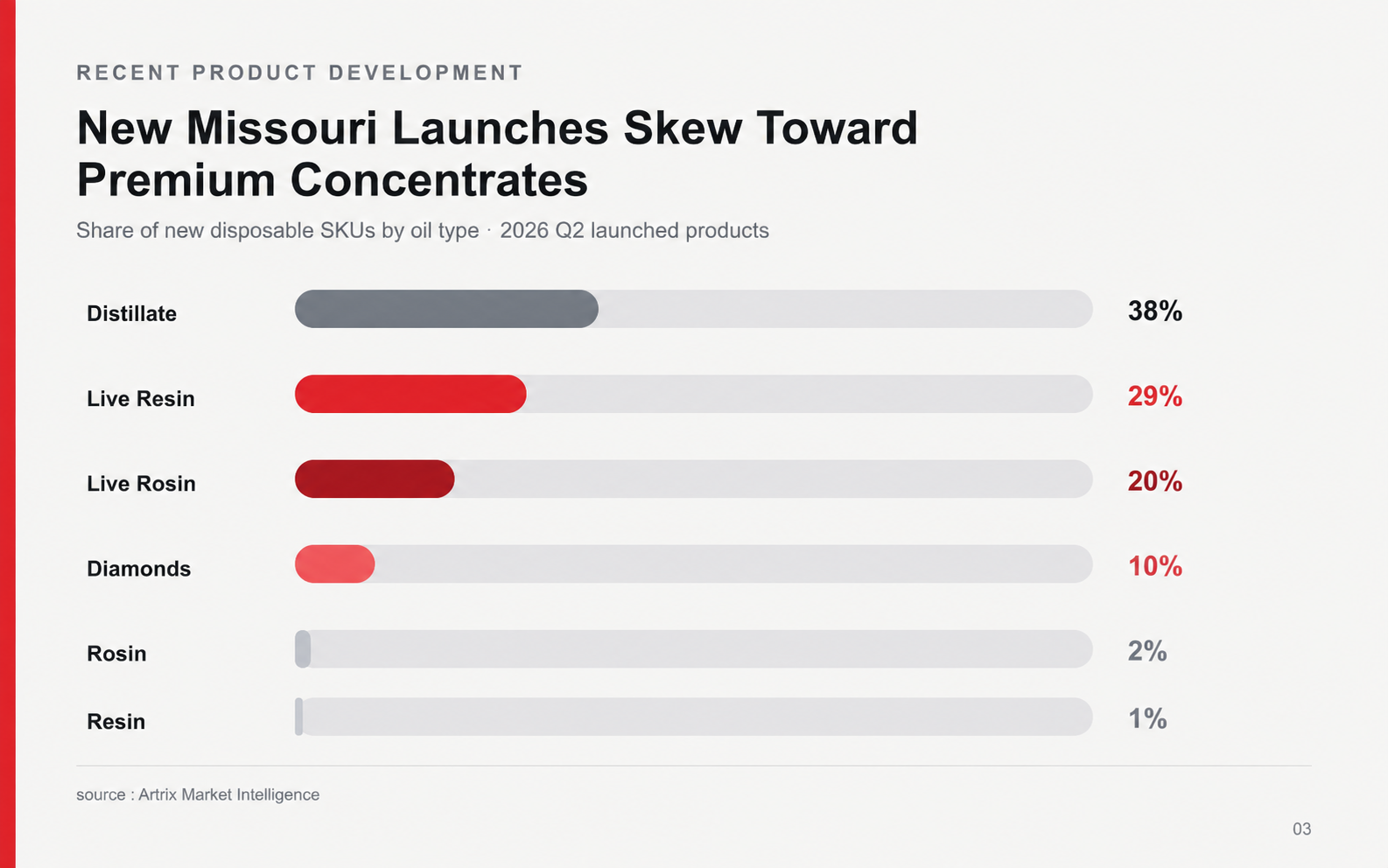
This difference between market share and new product development is an important signal. Distillate continues to support the current volume market, but brands are increasingly exploring Premium Extract categories as a way to create new product positioning.
Within the mainstream segment, flavored oils remain an important product expression. Instead of relying primarily on native cannabis oil characteristics or strain-based positioning, flavored oils focus on familiar consumer-facing profiles such as:
-
-
Fruit;
-
-
-
Sweet;
-
-
-
Dessert;
-
-
-
Cooling.
-
These profiles make product experiences easier to understand and allow brands to create clearer identities in a crowded market.
Cooling profiles, in particular, are becoming an increasingly visible direction within flavored oils. Rather than replacing traditional fruit or sweet profiles, cooling creates additional combinations such as Berry Ice, Strawberry Ice, and Watermelon Ice, allowing brands to differentiate through sensory experience rather than simply adding more SKUs.
Premium Extracts Are Creating New Product Positions
If flavored oils represent the mainstream segment, Premium Extract represents a different product direction.
Live Resin, Live Rosin, and other solventless extract products are positioned around the characteristics of the oil itself, including terpene expression, natural flavor profiles, extract properties, and overall product perception.
Market data shows that Live Resin maintains a stable premium position in Missouri’s disposable vape market, representing approximately 11%–14% of the category.
At the same time, new product development indicates that brands are increasingly exploring Premium Extract categories. The combined share of Live Resin and Live Rosin among recent disposable launches reaches 49%, exceeding Distillate’s share of new product introductions.
This does not mean Premium Extracts are replacing Distillate. Instead, the market is developing different product positions. Distillate continues to serve the mainstream category, while Premium Extracts create opportunities for products built around oil characteristics, flavor complexity, and extract differentiation.
Liquid Diamonds represent another emerging direction within this evolution. Market data shows Liquid Diamonds increasing from approximately 0.2% to 4.3% of the disposable oil category. This growth reflects broader exploration beyond traditional Distillate, although the category remains an emerging segment rather than the current market foundation.
2g Is Expanding the Role of Disposable Hardware
While oil categories influence what is inside the product, capacity is changing how consumers experience the product itself.
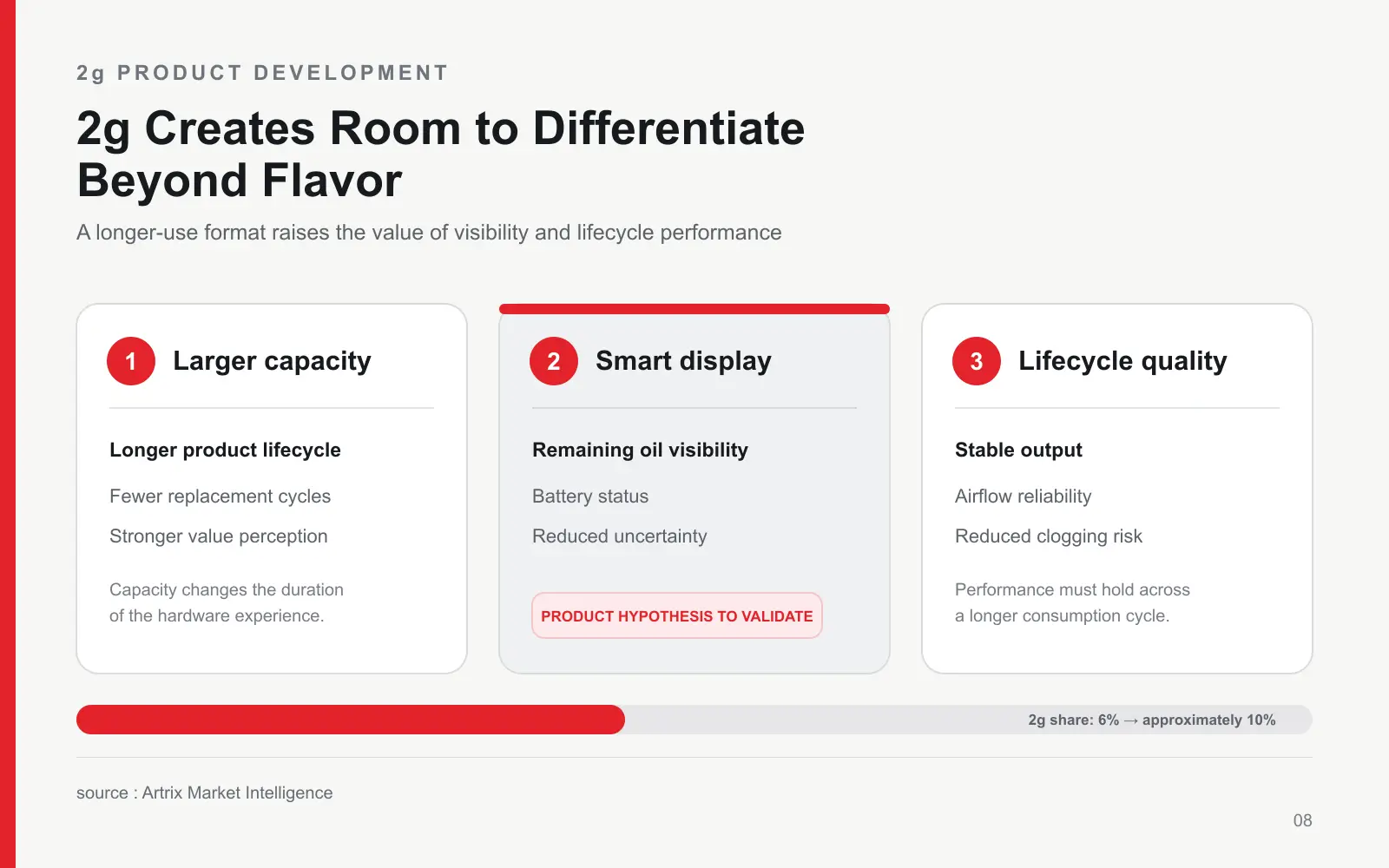
Historically, 1g has been one of the most common disposable vape formats. However, larger-capacity products are gaining adoption, with 2g products increasing from approximately 6% to 9%–10% of unit volume.
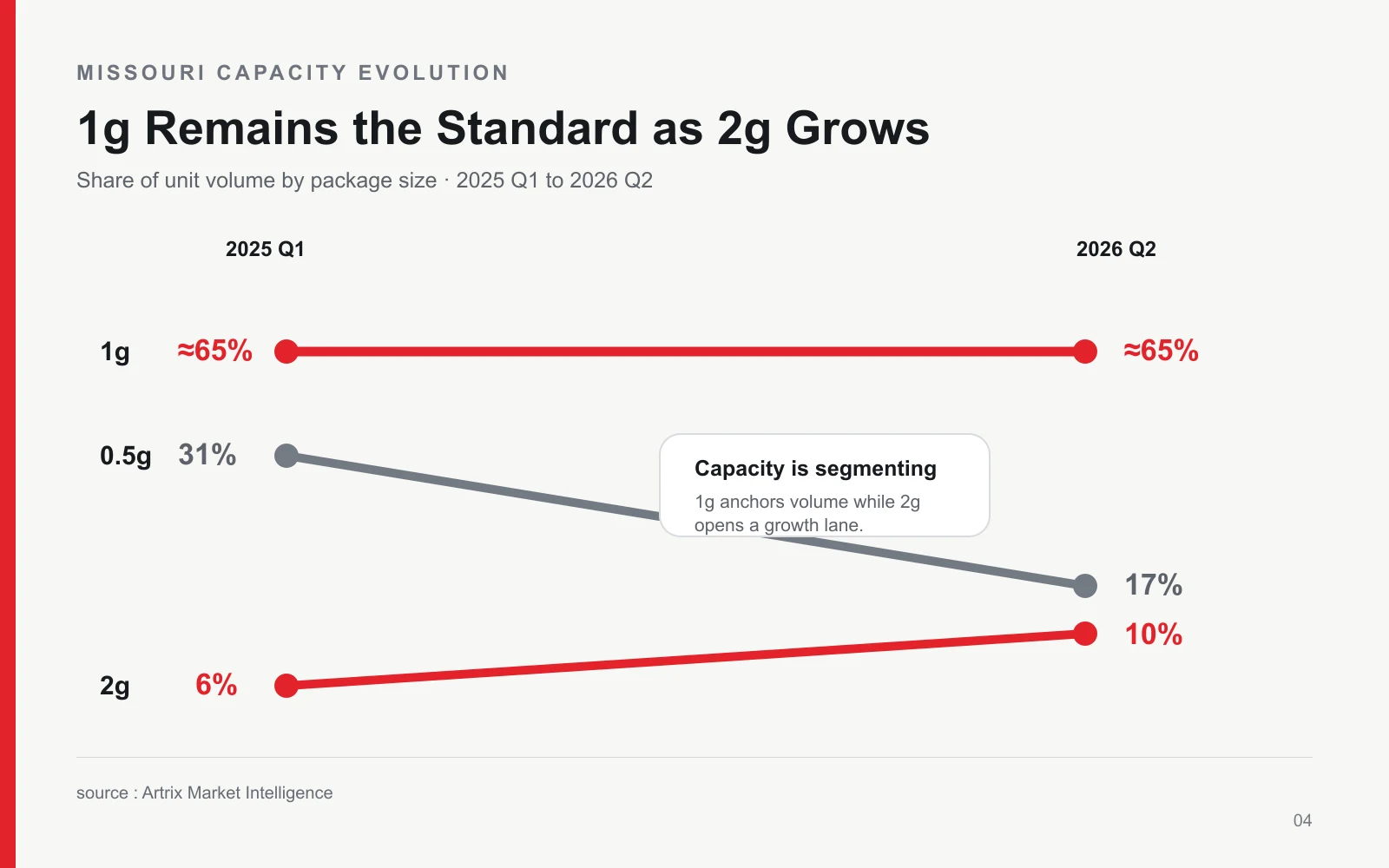
The importance of 2g is not simply that it provides more oil. A larger format changes the relationship between consumers and the device by extending the usage cycle and increasing the importance of long-term product performance.
As products are used over a longer period, hardware requirements become more demanding. Brands need to consider factors such as:
-
-
Battery performance;
-
-
-
Oil utilization;
-
-
-
Output consistency;
-
-
-
Long-term reliability.
-
For this reason, 2g is becoming more than a capacity specification. It is becoming a platform for exploring new product experiences and hardware architectures.
What These Market Shifts Mean for Product Development
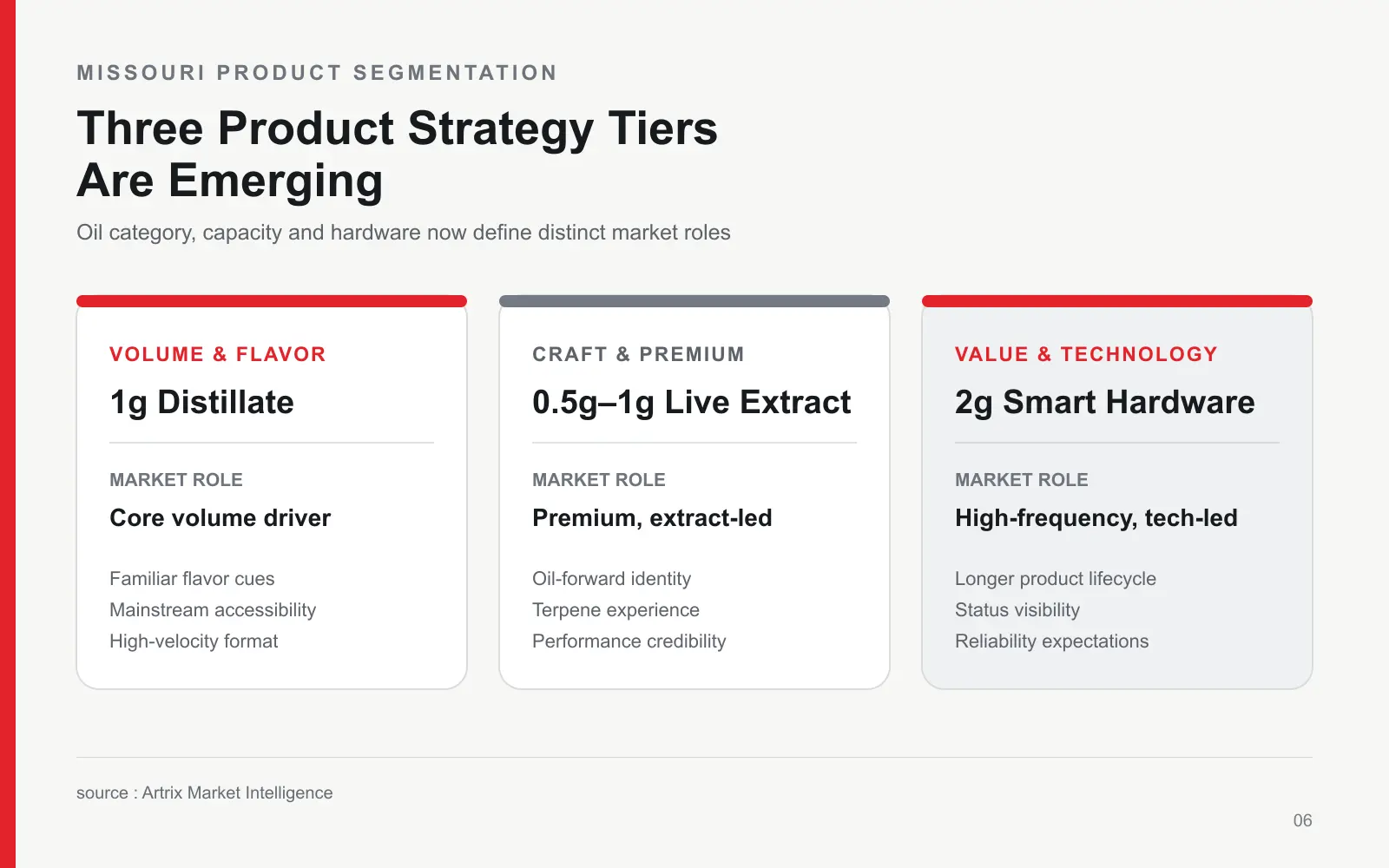
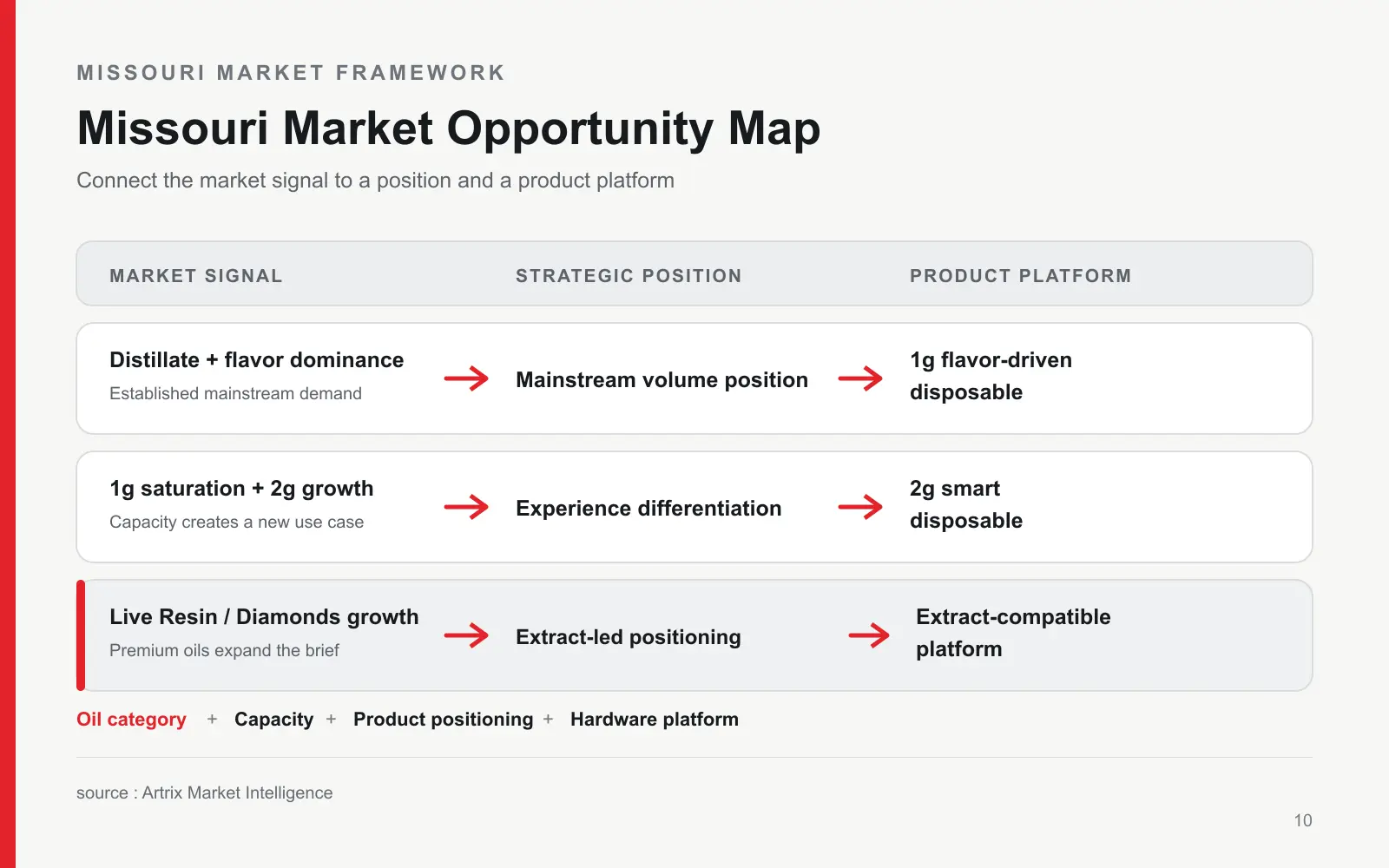
As Missouri’s vape market becomes more segmented, different product strategies create different hardware requirements.
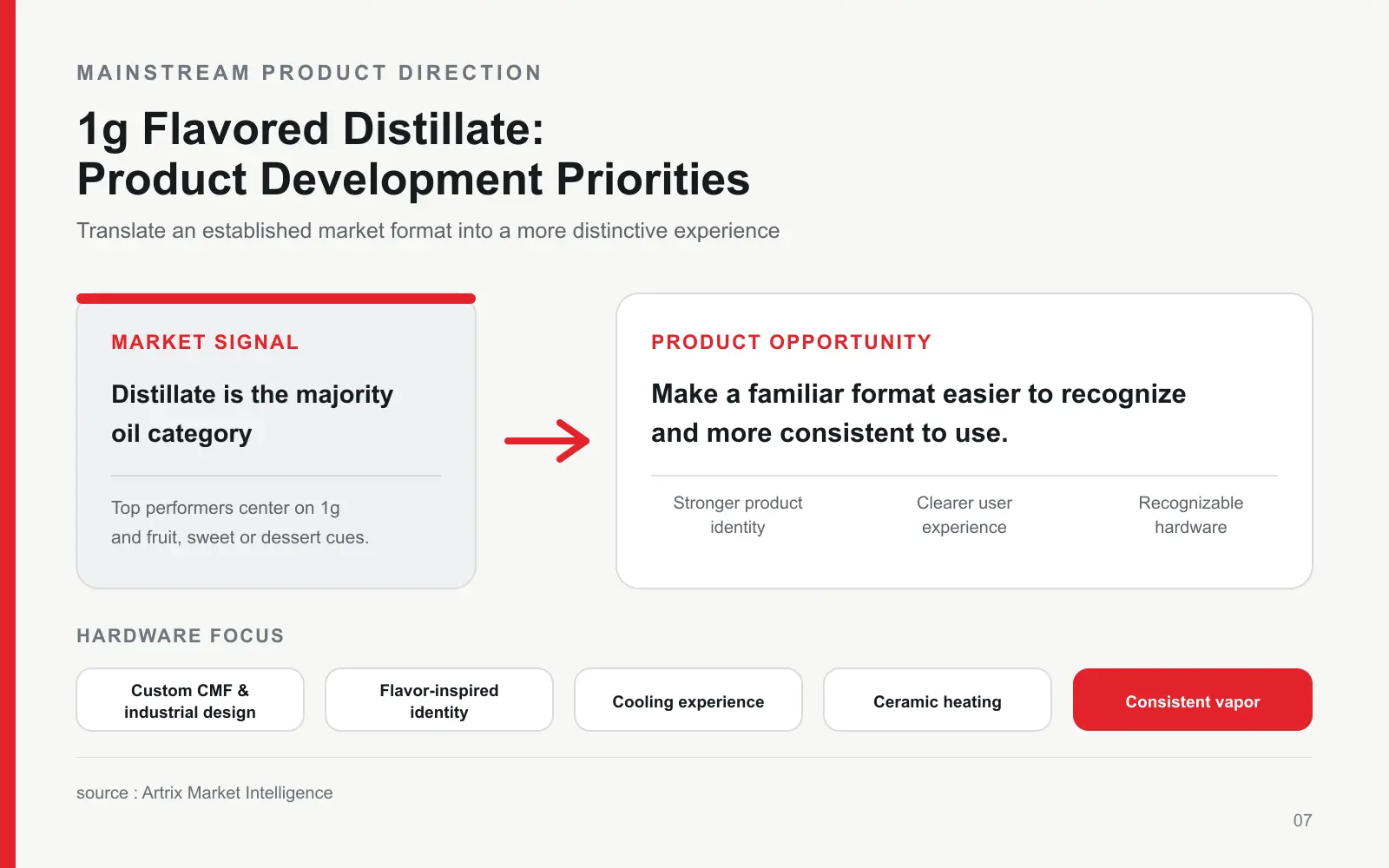
For mainstream Distillate and flavored oil products, the priority remains consistent performance at scale. Heating stability, airflow consistency, and manufacturing reliability become critical because these products compete through repeatable consumer experiences.
For Live Resin and Live Rosin products, hardware requirements become more closely connected with oil characteristics. Compatibility, thermal management, and flavor preservation become increasingly important because the hardware must support the intended value of the extract.
For larger-capacity formats such as 2g, the challenge shifts toward lifecycle performance. Longer usage periods require stronger battery capability, efficient oil utilization, and stable output throughout the product’s lifespan.
As the market continues to diversify, product development will require closer alignment between:
Oil category + Capacity + Product positioning + Hardware platform
Conclusion: Missouri’s Vape Market Is Moving Toward a More Diverse Product Ecosystem
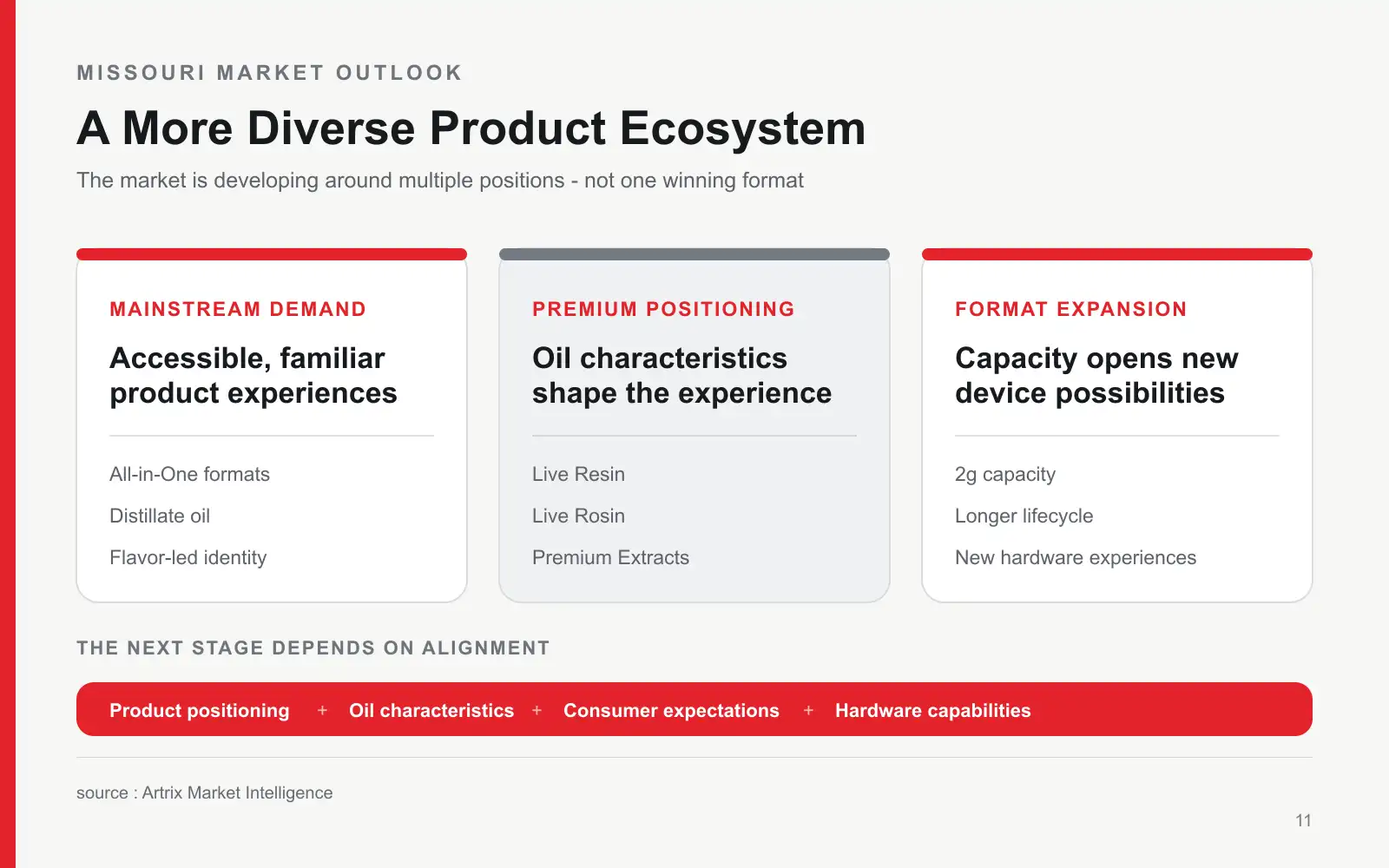
Missouri’s cannabis vape market is not moving toward one single winning product format.
Instead, different product categories are developing around different market positions.
AIO, Distillate, and flavored oils continue to support mainstream demand.
Live Resin, Live Rosin, and Premium Extract categories are creating new opportunities for premium positioning.
Larger-capacity formats such as 2g are expanding the possibilities of disposable product experiences.
The next stage of Missouri’s vape market will be shaped by how effectively brands align product positioning, oil characteristics, consumer expectations, and hardware capabilities.
Find the Right Product for Missouri
This article highlights the major market shifts shaping Missouri’s cannabis vape category.
Turn market signals into a product strategy.
Artrix can help you evaluate device format, capacity, oil compatibility, and positioning for your next Missouri launch.