

-1.webp)
-1.webp)
-2.webp)





































The CBD Sleep Trial Most Customers Accidentally Run Wrong
CBD for sleep is often tested in a way that makes the result almost impossible to understand. A person may switch from gummies to oil, raise the dose, take it later at night, add melatonin, change caffeine habits, and then decide CBD “worked” or “failed” after two nights.
A better approach is to treat CBD as one possible relaxation tool, not a guaranteed insomnia treatment. CBD may help some adults feel calmer, less restless, or more comfortable before bed, but it does not solve every sleep problem. Current research is still mixed, and regulators continue to warn that CBD products carry real safety considerations, including drug interactions and sedation risks when combined with alcohol or other sleep-related medications.
This guide explains how to run a more useful personal CBD sleep trial: when to take it, how to start low, who should be cautious, which format may fit trouble falling asleep, how CBD + CBN compares with CBD + melatonin, and whether a 10 mg or 25 mg starting dose makes more sense.

Why Most CBD Sleep Trials Give Confusing Results
The most common CBD sleep mistake is changing too many things at once. If someone takes 10 mg CBD oil on Monday, 25 mg CBD gummies on Tuesday, CBD + CBN on Wednesday, and CBD + melatonin on Thursday, the body never gets a fair comparison. The result may feel random because the test was random.
The Problem With Changing Dose, Format, and Routine Together
CBD products vary by delivery route, dose, cannabinoid profile, and timing. Gummies need digestion. Oils may absorb partly through the mouth and partly through the digestive system. Vapes act faster but fade differently and introduce inhalation considerations. If those formats are mixed without tracking, the user cannot tell whether the result came from CBD, timing, product type, fatigue, stress, food, alcohol, or placebo effect.
A cleaner trial holds most variables steady. Use one product, one dose, one timing window, and one bedtime routine for several nights before judging. If the goal is to test CBD for sleep, the trial should not also test a new mattress, a new workout schedule, a new screen habit, and a new supplement stack.
A Simple 7-Night Trial Framework
For a basic personal test, choose one CBD product and use it at the same time each evening for seven nights. Track four things:
- How long it took to fall asleep
- How often you woke up
- How you felt in the morning
- Whether any side effects appeared
A simple note such as “25 mg oil, 75 minutes before bed, fell asleep faster, woke once, slight dry mouth” is more useful than a vague “slept better.”
When to Take CBD Before Bed
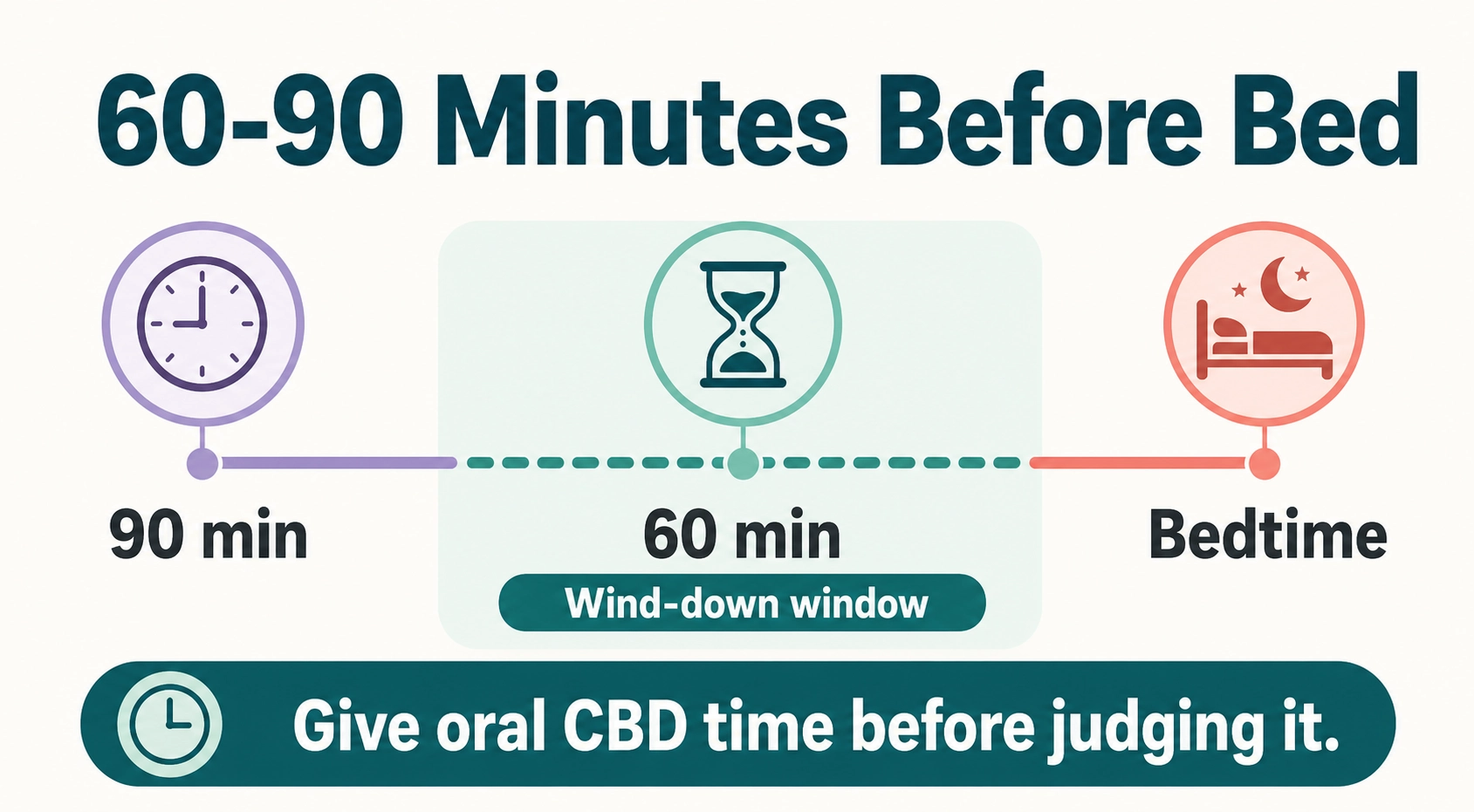
A practical starting window for many oral CBD products is 60 to 90 minutes before bedtime. This does not mean CBD always takes exactly that long to work. It means the user is giving the product enough time to enter the bedtime routine before judging whether it supports relaxation.
Why 60 to 90 Minutes Is a Reasonable Starting Point
CBD oils and gummies usually do not behave like an instant switch. Gummies must be digested, and oils can still take time depending on how they are used. Taking CBD only five minutes before lying down may lead someone to think the product failed, when the timing was simply too late.
One clinical pilot study tested 150 mg of nightly CBD in adults with moderate to severe primary insomnia, with cautious and mixed findings rather than a universal sleep cure. That kind of evidence is useful because it reminds readers that timing, dose, and outcome measures matter. Feeling calmer before bed is not the same as proving insomnia has been treated.
Why Taking CBD Too Late Can Affect the Next Morning
Late dosing can make the next morning harder to interpret. If a gummy is taken at midnight and the person wakes at 6:30 a.m., any grogginess may be related to timing, dose, poor sleep duration, or the product blend. This is especially important for products that combine CBD with CBN, melatonin, THC, or other calming ingredients.
The better test is to take the product earlier in the wind-down window and leave enough room before waking. If morning heaviness keeps happening, the first adjustment should often be timing or dose before switching to a stronger product.
How to Take CBD for Sleep: Start Low and Increase Gradually
The safest practical approach for a non-prescription CBD sleep routine is to start low, increase gradually only if needed, and avoid stacking it with alcohol or sedating medications unless a clinician says it is appropriate. CBD is widely sold, but “widely sold” does not mean risk-free.
What “Start Low and Go Slow” Means in Practice
For many adults, a low starting dose may mean beginning around 10 mg CBD in the evening, then observing the result for several nights. If there is no benefit and no unwanted effect, some people may consider increasing gradually, such as moving toward 25 mg. The key is to avoid jumping from a small dose to a high dose after one impatient night.
This matters because CBD can interact with other substances and medications. Anyone using prescription medication, sleep aids, anti-anxiety medication, or liver-related medication should be more cautious. For cannabis brands and product teams, clear CBD product quality standards also matter because sleep-related products are judged not only by flavor or format, but by consistency, testing, and responsible communication.
What to Track Before Increasing the Dose
Before raising the dose, track whether CBD changed the actual sleep problem. Did it help the user fall asleep faster, or only feel more relaxed while still awake? Did it reduce middle-of-the-night waking, or only make the user care less about waking? Did the morning feel clearer, heavier, or unchanged?
A useful CBD sleep trial should track both bedtime and next-day experience. If the user feels calmer but foggier, that is not an automatic win. The best result is not “maximum sedation.” It is controlled relaxation with a better morning.
CBD Dosing for Sleep: 10 mg vs 25 mg
A 10 mg CBD starting dose is often better for cautious first testing, while 25 mg may make sense for adults who have already used CBD without issues and want a stronger but still moderate trial. Neither number is a universal medical standard. They are practical comparison points for consumer self-observation.
When 10 mg Makes More Sense
A 10 mg starting point is useful for first-time CBD users, smaller-bodied users, people sensitive to supplements, and anyone worried about next-morning grogginess. It is also a cleaner choice when the user wants to know whether even a small amount changes the bedtime experience. If 10 mg helps, there may be no reason to raise the dose.
Starting at 10 mg also reduces the chance of confusing product strength with product fit. If a person begins too high and dislikes the result, they may reject CBD entirely when the real issue was dose, timing, or formulation.
When 25 mg May Be Worth Testing
A 25 mg dose may be considered after a low-dose trial produces no meaningful effect and no side effects. It may also fit users who already tolerate CBD and are trying to manage evening tension, physical restlessness, or stress-related difficulty relaxing. Still, more CBD does not automatically mean better sleep.
Some clinical research uses much higher CBD doses than typical consumer starting points, but that does not mean consumers should copy research protocols at home. Research settings have screening, monitoring, and defined outcomes. A home routine should stay conservative and focus on whether the user’s real problem improves.
CBD Gummies vs Oils vs Vapes for Trouble Falling Asleep
| Format | Best fit | Main tradeoff |
|---|---|---|
| CBD oil | Often the most balanced format to test first for trouble falling asleep. | Requires consistent timing and measuring. |
| Gummies | Easiest to dose and repeat during a bedtime routine. | Usually slower because they pass through digestion. |
| CBD vapes | Fastest option when rapid onset is the main concern. | Not automatically the best bedtime option because of inhalation and device-quality considerations. |
The “superior” format depends on whether the problem is timing, consistency, sensitivity, or the need for rapid onset.
Gummies: Simple, Consistent, and Slower
CBD gummies are convenient because the dose is pre-measured. That makes them friendly for a 7-night trial. A person can take the same gummy at the same time and compare the result without measuring drops or changing technique.
The tradeoff is speed. Gummies usually need more time because they pass through digestion. For someone who suddenly feels anxious at bedtime and wants fast relief, gummies may feel too slow. For someone who plans a routine 60 to 90 minutes before bed, they may work better.
Oils and Vapes: Faster Adjustment, Different Trade-Offs
CBD oil may be easier to adjust than gummies because the dose can often be changed in smaller steps. It also fits a controlled evening routine well. For many users, oil is the most practical first comparison against gummies because it balances timing, flexibility, and repeatability.
CBD vapes may act faster, which can appeal to people who mainly struggle with sleep onset. However, vaping cannabis is not the same kind of wellness choice as taking an oral product. It introduces inhalation exposure, device quality concerns, and local legal or age restrictions. For sleep content, vapes should be discussed carefully and positioned as a format with speed advantages, not as the default “healthier” option.
CBD + CBN vs CBD + Melatonin
CBD + CBN and CBD + melatonin are two different sleep strategies. CBD + CBN focuses on a cannabinoid-based relaxation profile, while CBD + melatonin focuses more directly on the body’s sleep timing signal. Neither blend should be presented as universally better.
CBD + CBN: A Cannabinoid-Based Sleep Blend
CBN is often marketed as a sleep cannabinoid, but the evidence is still developing. Product dose, purity, other ingredients, and the user’s baseline sleep problem all matter. Consumers should not treat every CBN product claim as proven simply because the ingredient appears in a nighttime formula.
CBD + CBN may be more interesting for users who want a cannabinoid-centered evening routine and do not want melatonin. It may also appeal to users who feel melatonin leaves them groggy or gives them vivid dreams. But that preference is personal, not proof that CBN is stronger for everyone.
CBD + Melatonin: A Timing-Focused Option
CBD + melatonin may fit people whose main issue is sleep timing, such as difficulty shifting into a bedtime rhythm. Melatonin is not simply a stronger sleep sedative; it is commonly used as a circadian timing aid. That means the timing of use matters, and taking too much or taking it too late may create a poor experience for some users.
One randomized trial compared cannabinoid and melatonin formulations, including products containing 15 mg CBD or 5 mg melatonin. Findings like this are useful, but they still do not prove that every CBD + melatonin gummy will work the same way. The product formula and the user’s sleep issue remain central.
Who Should Be Cautious, Who May Not Benefit, and Who Might Find CBD Useful
CBD may be worth testing for some adults with stress, discomfort, or restlessness before bed, but it is not the right first answer for every sleep complaint. People with possible sleep apnea, serious insomnia, medication interactions, pregnancy, liver concerns, or heavy alcohol use should be especially cautious.
Groups That Should Exercise Caution
Anyone taking prescription medication should check with a qualified professional before using CBD regularly. This is especially important for medications processed by the liver, sedatives, anti-anxiety drugs, sleep medications, and substances that already cause drowsiness. People who are pregnant, breastfeeding, underage, or managing a diagnosed medical condition should not treat CBD as a casual bedtime experiment.
CBD may also be ineffective when the real issue is untreated sleep apnea, chronic pain that needs medical care, severe anxiety, shift-work disruption, alcohol-related sleep fragmentation, or poor sleep hygiene. If a person wakes gasping, snores heavily, feels dangerously sleepy during the day, or has persistent insomnia, CBD should not delay medical evaluation.
Who Might Find CBD Helpful
CBD may be more useful for adults whose sleep difficulty is connected to evening tension, stress, discomfort, or an inability to relax after the day. In those cases, the realistic goal is not to force sleep. It is to reduce friction around the bedtime transition.
The most believable positive outcome sounds like this: “I felt calmer, fell asleep a little easier, and woke up without feeling worse.” That is a useful experience. It is also more responsible than claiming CBD cures insomnia.
How to Decide Whether Your CBD Sleep Trial Worked
A CBD sleep trial worked only if it improved the specific problem the user was testing without creating a worse next-morning tradeoff. Feeling sedated is not enough. The user should be able to describe the improvement clearly.
Signs CBD Helped the Experience
Good signs include falling asleep with less frustration, waking fewer times, feeling less physically restless, or having a calmer evening routine. Another good sign is consistency: the result appears over several nights, not only once after an exhausting day.
Bad signs include next-day fogginess, dry mouth that disrupts sleep, anxiety about the effect, inconsistent results, or needing to raise the dose repeatedly. If the product works only when stacked with alcohol or multiple sedating ingredients, that is not a clean or low-risk sleep ritual.
When to Stop Testing
Stop the trial if side effects appear, if sleep gets worse, or if the product encourages heavier and heavier dosing. Also stop if the sleep issue looks medical rather than routine-related. CBD should not be used to cover up symptoms that need diagnosis.
Bottom Line: Test CBD Like a Sleep Variable, Not a Miracle Ingredient
CBD for sleep is most useful when approached as a controlled personal experiment. Start with a low dose such as 10 mg, consider 25 mg only after several uneventful nights, take oral products around 60 to 90 minutes before bed, and keep the product format consistent. Oils may offer the best balance for many first tests, gummies offer convenience, and vapes offer speed with added tradeoffs.
CBD + CBN may suit users who want a cannabinoid-based routine, while CBD + melatonin may suit users focused on sleep timing. The right choice depends on the user’s body, schedule, product quality, and sleep problem. For brands such as Artrix, the strongest content opportunity is not to promise that CBD fixes sleep. It is to help customers run a safer, clearer, more honest trial.