


-1.webp)
-1.webp)
-2.webp)































How to Choose a Cannabis Vape Hardware Supplier: A Practical Due-Diligence Guide
Last Updated: Sep 1, 2026
Choosing the right wholesale vape supplier is a critical decision that can make or break your vape retail business, requiring careful evaluation of multiple factors from product quality to regulatory compliance. For a cannabis brand, however, supplier selection involves more than comparing catalogs and unit prices. The strongest candidate should fit the intended device format, extract characteristics, launch market, quality expectations, order volume, and development schedule.
Start with five questions: Can the supplier support the product you intend to build? Can it show how quality is controlled? Are its documents relevant to the exact model and market? Do its commercial terms fit your cash flow? Can it respond when production or field problems occur? The answers create a more useful basis for comparison than broad promises about quality, speed, or compliance.
Define the Project Before Comparing Suppliers
A useful supplier search begins with a written product brief. Without one, quotations may describe different materials, batteries, heating systems, packaging, testing scopes, or levels of customization. A lower quote may therefore represent a narrower deliverable rather than a genuinely better offer.
The brief should identify the device format, target market, intended extract category, expected fill process, capacity range, branding requirements, forecast volume, preferred launch window, and any known packaging or distribution constraints. Avoid asking a hardware supplier to declare that a finished cannabis product is universally “compliant.” Requirements can depend on intended use, product contents, claims, sales channel, destination, and state or local rules.
Key Points for Evaluating Wholesale Vape Suppliers
Not all wholesalers are created equal. Claims about quality, delivery, pricing, and compliance should be converted into evidence that a buyer can inspect rather than accepted as general assurances.
1. Product Range & Quality
Product range matters only when it is relevant to the project. For cannabis hardware, compare experience with the required format, such as all-in-one devices, 510 cartridges, pods, or portable concentrate devices. A long catalog does not establish compatibility with a particular extract or filling process.
Quality should be evaluated as a process rather than a slogan. Ask how the supplier controls incoming components, assembly, sealing, heating performance, aging, traceability, and nonconforming units. When reviewing test results, check the model, sample size, conditions, acceptance criteria, date, and laboratory. A report for a similar device is not proof for the product being ordered.
Extract compatibility deserves its own validation step. Oil viscosity, formulation, hardware geometry, heating behavior, storage orientation, and environmental conditions may affect the user experience. A sample program can help identify potential problems before scale-up, but no general mechanism or material choice can guarantee zero leakage, consistent flavor, or a specific service life without product-specific testing.
2. Pricing & Terms
Beyond the base wholesale price, consider potential hidden fees or additional surcharges. You’ll also want clarity on minimum order quantities (MOQs) and return policies for defective products. Compare total landed cost rather than unit price alone. Relevant items may include samples, engineering, tooling, packaging, inspection, freight, duties, payment fees, spare units, rework, and the financial effect of holding excess inventory.
Request a line-item quotation that states the quotation period, Incoterm, payment schedule, tooling ownership, forecast assumptions, price breaks, and conditions that can change the price. If exclusivity is offered, the contract should identify the design, territory, term, volume commitment, exceptions, and what happens if either party ends the relationship.
3. Supplier Reliability & Reputation
Shipping delays, incorrect orders, or poor communication can undermine your business’s reputation. Research a supplier’s track record in forums, review sites, or business directories. Public reviews can identify questions to investigate, but they should not replace operational evidence. Ask for references relevant to your product type, a sample production schedule, escalation contacts, and examples of how the supplier records corrective action.
4. Customer Service
Excellent customer service separates a forgettable supplier from a vital partner. You want quick, helpful communication and a willingness to fix problems promptly when issues arise. Test this capability during qualification. Send every candidate the same technical question and note the response time, the specificity of the answer, whether an engineer becomes involved, and whether the supplier proposes a verification method.
5. Shipping & Lead Times
Fast, reliable shipping and transparent lead times help you keep your shelves stocked. Lead time should be divided into design, sample preparation, approval, material procurement, production, inspection, and transport. This makes it easier to identify where a delay occurred and whether the launch plan still has enough buffer.
6. Regulatory and Documentation Readiness
Compliance is non-negotiable. However, “compliant” is not a complete specification. Buyers should identify the rules that may apply to the intended device, substance, transaction, market, packaging, and shipping method, then verify each document against that scope.
In the United States, FDA tobacco-product requirements apply to electronic nicotine delivery systems and their regulated components, while new tobacco products generally require an applicable written marketing order before legal marketing. This does not make a generic FDA statement sufficient for cannabis hardware. The FDA marketing-order framework should be reviewed only when it matches the product’s intended regulatory category.
Shipping analysis requires separate attention. The federal PACT Act definition of an electronic nicotine delivery system includes devices that deliver nicotine, flavor, or another aerosolized substance; ATF materials expressly refer to devices delivering CBD, THC, Delta-8, and Delta-9. Businesses involved in covered interstate sales or shipments should review the PACT Act requirements and applicable state obligations with qualified advisers.
Child-resistant packaging language must also be precise. The federal Child Nicotine Poisoning Prevention Act applies to covered liquid nicotine containers, and the CPSC describes an exclusion for certain sealed, prefilled disposable containers when the liquid is inaccessible during customary or reasonably foreseeable handling. The CPSC packaging guidance should not be presented as a universal certification for every vape or cannabis device. State cannabis packaging rules may impose separate requirements.
For every report or certificate, confirm the issuing body, holder, model, materials, standard version, date, and validity. Testing against a standard is not the same as certification, and a company statement is evidence of what the company offers—not independent proof that a product achieved a performance result.
Distributor, OEM, or ODM: Choose the Right Sourcing Model
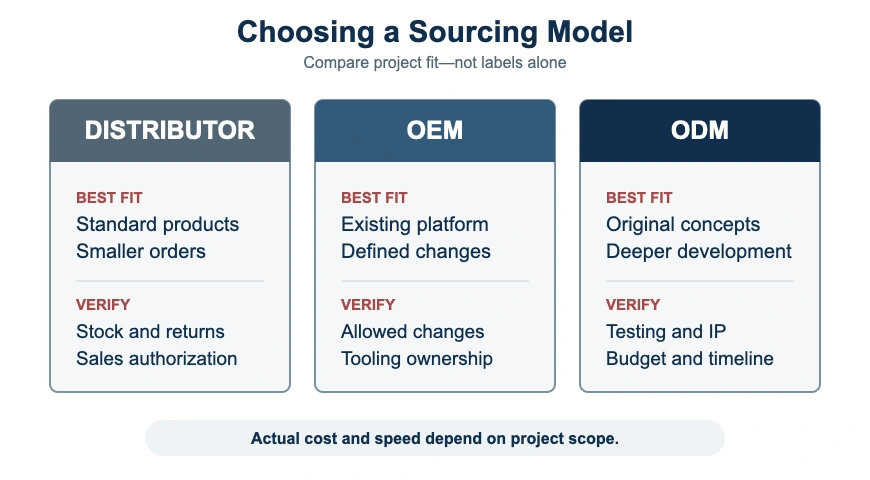
Local distributors may be convenient for standard products, smaller orders, or faster replenishment, while direct manufacturing relationships may provide more room for customization. Neither route is automatically faster or less expensive: the best option depends on order size, inventory availability, engineering needs, logistics, and the level of differentiation required.
| Sourcing model | Best-fit scenario | Practical advantage | Evidence or limitation to check |
|---|---|---|---|
| Local distributor | Smaller orders, standard products, or urgent replenishment | May simplify communication, local availability, and smaller-volume purchasing | Customization may be limited; verify authorization, stock ownership, and return terms |
| OEM or platform customization | A proven supplier platform with branding or defined component changes | May shorten development compared with a new architecture | Confirm which changes are allowed, who owns tooling, and whether the platform is shared |
| ODM or original development | A differentiated product requiring design and engineering work | Can support deeper structural, functional, or visual development | Usually requires more validation, time, budget, and clear intellectual-property terms |
OEM product services typically include modifications to product appearance, components, oil windows, capacity, and other aspects. The specific costs and timeframes are generally determined based on the difficulty of customization. Because suppliers use OEM and ODM differently, compare the actual scope of work rather than relying on the label. The contract should state responsibility for industrial design, engineering, prototyping, testing, tooling, manufacturing, packaging, change control, and ownership of deliverables.
A Five-Step Supplier Verification Process
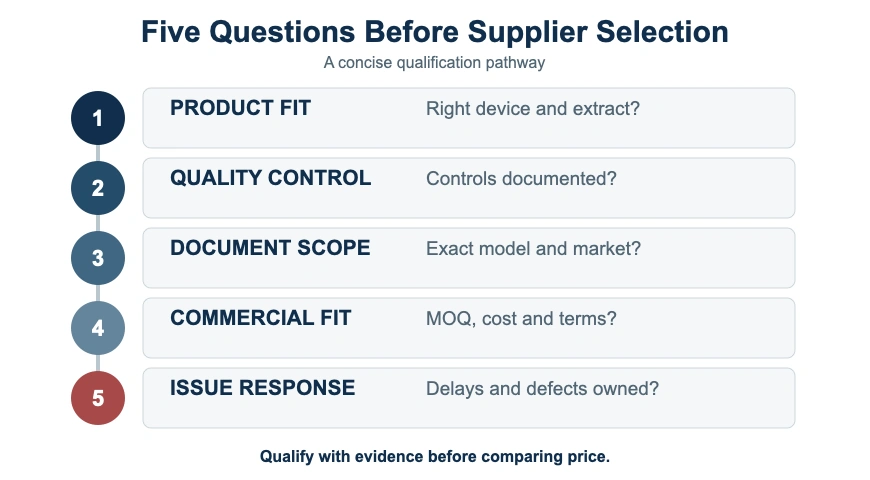
A repeatable verification process makes supplier comparisons more objective and reduces the chance that an attractive sample or quotation controls the entire decision. The process should move from inexpensive document checks to more expensive production commitments.
-
- Screen the supplier against the written product brief, target market, budget, schedule, and sourcing model.
-
- Review company details, relevant experience, references, document scope, quotation assumptions, and intellectual-property terms.
-
- Evaluate samples under conditions that reflect the intended extract, filling method, storage, transport, and use case. Record the method and result rather than relying on informal impressions.
-
- Approve a pilot or pre-production batch with written specifications, acceptance criteria, traceability, and change-control rules.
-
- Finalize the quality agreement, production schedule, inspection plan, defect process, shipping responsibilities, and escalation contacts before mass production.
Avoid promoting pilot findings as universal performance claims. A result applies only to the tested model, configuration, extract, sample, method, and environment unless broader validation supports a wider conclusion.
Supplier Red Flags to Investigate
-
- Reports or certificates do not match the quoted model, material, holder, or current standard version.
-
- The supplier guarantees “zero leakage,” universal compatibility, or complete compliance without disclosing tests and limitations.
-
- Tooling, design ownership, exclusivity, or territory rights are not defined in writing.
-
- Production begins before a controlled sample and specification are approved.
-
- The quotation hides engineering, packaging, inspection, freight, or defect-resolution costs.
Questions to Ask Before Requesting a Final Quote
What product-specific evidence should a supplier provide?
Ask for evidence that matches the quoted model and intended configuration. Depending on the project, this may include specifications, bills of materials, sample records, test methods, inspection criteria, traceability information, and applicable market documents. Verify scope rather than counting documents.
How should a brand compare MOQs?
Compare the cash commitment, unit economics, tooling, inventory exposure, price-break conditions, and likely reorder schedule. A lower MOQ can reduce initial exposure, while a larger order may improve unit pricing; neither is automatically better without a demand and cash-flow model.
Does one successful sample prove compatibility?
No. A sample can support an initial decision, but repeatability depends on the approved specification and production controls. Confirm the test setup, use representative materials, and verify the pilot or production batch against written acceptance criteria.
Make the Decision with Evidence, Not Labels
The right cannabis vape hardware supplier is the one whose capabilities, evidence, terms, and working process fit the specific project. A structured brief, comparable scorecard, controlled sample process, and written commercial agreement provide a stronger foundation than brand recognition or the lowest quoted price alone.
After completing that comparison, brands that see a fit with Artrix can review the ArtrixMake service or contact the Artrix team to request product-specific options, samples, pricing, and written terms.