

-1.webp)
-1.webp)
-2.webp)























How to Choose Ceramic Cores for Cannabis Vaporization Equipment? The Oil Adaptation Logic B2B Brands Must Understand
For cannabis vaporizer brands, extraction facilities, white-label brands, and MSOs (Multi-State Operators), vaporization hardware is not merely a container for oil.
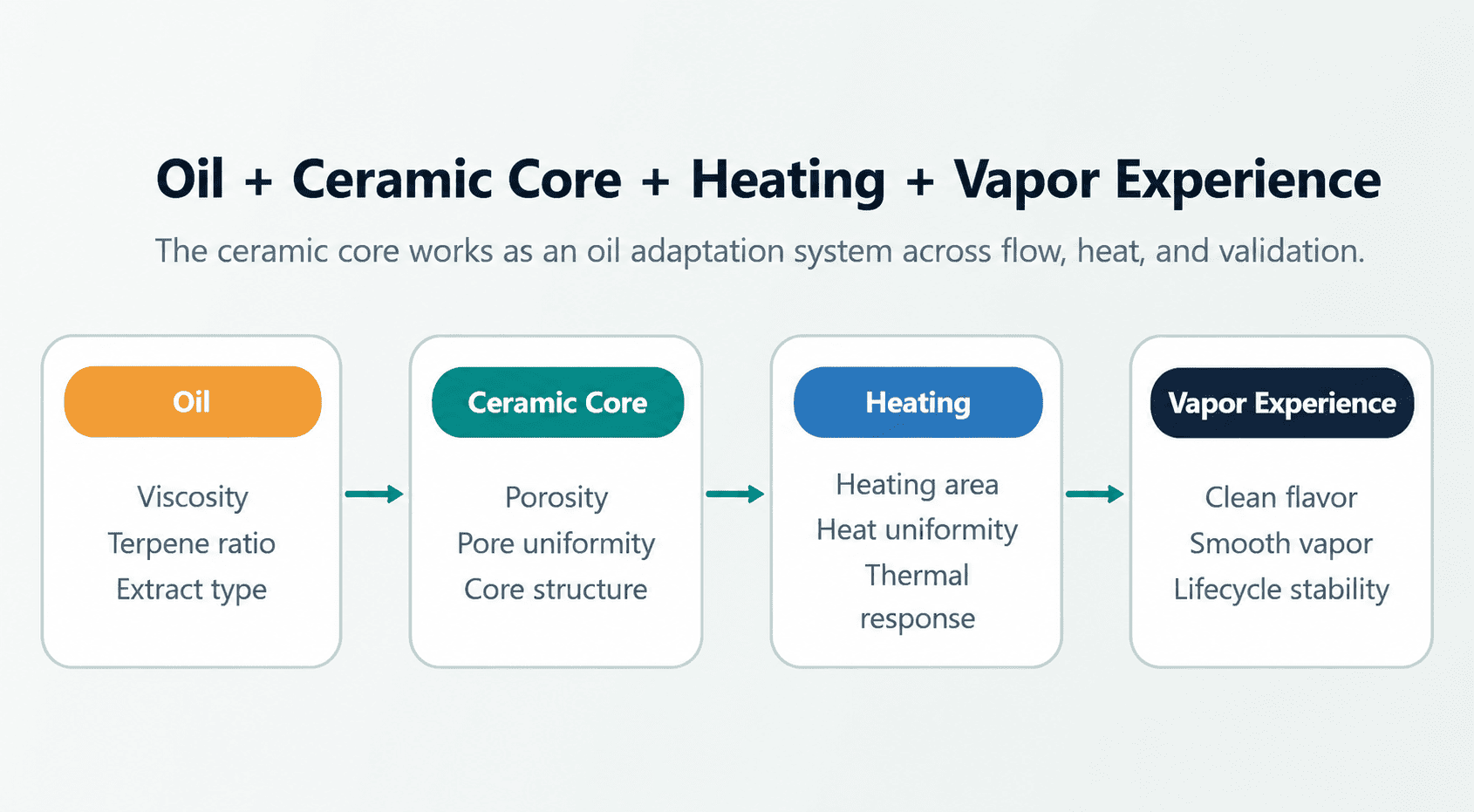
A cartridge, disposable, or pod delivered to consumers is not the raw oil in its laboratory state, but a complete experience shaped by hardware oil conduction, heating, and vaporization. What consumers actually perceive is whether the flavor is clean, the vapor is smooth, whether it clogs or leaks, whether it dry-hits (burnt core), and whether the entire product remains stable from the first puff to the last.
Therefore, the ceramic core is not just a simple material selling point. It directly impacts the flavor expression of high-value extracts, continuous draw performance, late-stage stability, and after-sales risks.
From a commercial perspective, hardware incompatibility is a direct threat to brand equity and bottom-line margins. A product launch suffering from poor oil adaptation can result in B2B return rates (RMA) exceeding 3%, adding $0.50 to $1.00 of unexpected return logistics costs per device, and ultimately risking delisting by major dispensaries due to negative consumer feedback.
In B2B purchasing, brands usually prioritize comparing appearance design, unit cost, MOQ, lead times, customization capabilities, and supplier quotes. These factors are indeed important, but they do not answer a more critical question: Does this vaporization equipment truly adapt to my oil?
Especially for Live Resin, Live Rosin, Rosin, high-terpene extracts, and high-viscosity distillates, the requirements for the ceramic core structure are even higher. If the ceramic core is incompatible with the oil, even if the product looks premium and the price is competitive, issues such as insufficient oil supply, burnt tastes, clogging, spitting, leakage, flavor degradation, poor late-stage experience, or batch inconsistency may arise after launch.
Thus, B2B brands choosing vaporization hardware should not just ask: “What kind of ceramic core is this?”
Instead, they should ask: “Does this ceramic structure, oil conduction logic, heating method, and material process fit my oil’s viscosity, terpene ratio, target users, and product positioning?”
Quick Answer
When B2B brands select ceramic cores for cannabis vaporization hardware, they should look beyond the generic term “ceramic core.” Instead, they must evaluate whether the ceramic structure aligns with their oil viscosity, terpene ratios, target flavor profiles, and mass-production consistency requirements.
Traditional cylindrical cotton-wrapped ceramics can improve initial oil supply for certain standard distillates. However, when applied to Live Resin, Rosin, and other high-value, flavor-focused extracts, they often present challenges such as cotton layer variability, manual assembly tolerances, localized hotspots, dry hits under continuous draw, and late-stage flavor degradation.
Planar pure ceramics and larger effective heating areas are better suited for products that emphasize clean vapor, pure taste, terpene expression, and late-stage consistency. However, this does not mean they are universally compatible with all oils. A truly reliable ceramic solution must be verified through specific extract testing, continuous draw testing, leakage testing, and mass-production consistency validation.
1. The Technological Shift: Cylindrical Cotton-Wrapped vs. Planar Pure Ceramics
In cannabis vaporization hardware, “ceramic core” is not a one-size-fits-all answer. Different ceramic cores can have completely different structural logics, and the choice between them represents a fundamental shift in material science and assembly methodology.
1.1 Cylindrical Cotton-Wrapped Ceramics: The Legacy Conduit
In early or traditional cannabis vaporization hardware, cylindrical ceramic was a common structural solution. Its advantages lay in structural maturity, extensive mass-production experience, and providing relatively stable basic performance for standard distillates and mass-market disposable products.
However, traditional cylindrical structures have an inherent limitation: the oil must pass through intake holes to enter the core area before contacting the ceramic heating surface.
Since the surface area of the intake holes is limited, when the hardware faces high-viscosity oil, relying solely on the oil’s own flow and the capillary suction of the ceramic may fail to replenish the heating surface in time during continuous draws.
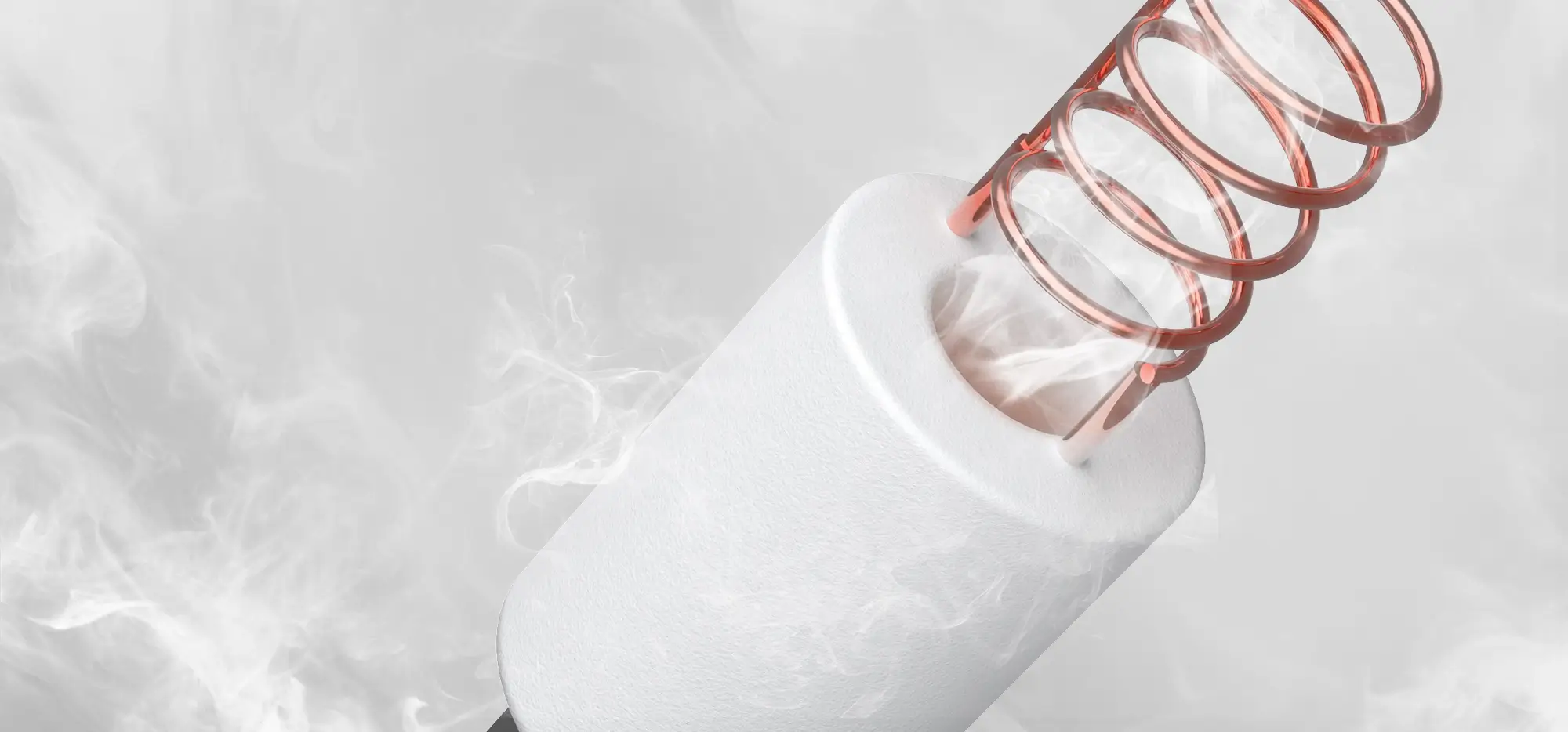
Therefore, cylindrical cotton-wrapped ceramics usually feature a layer of cotton or oil-absorbent material wrapped around the outside of the ceramic heating element. The outer cotton or oil-absorbent material uses capillary action to pull the oil from the intake holes and distribute it around the ceramic, thereby improving the wetting state of the ceramic surface and reducing dry hits under standard usage.
1.2 The Legacy Limitations: How High-Value Extracts Amplify Cotton & Sintering Variables
While cylindrical cotton-wrapped ceramics might perform acceptably with standard distillates, their structural limitations are significantly amplified when used with high-value extracts like Live Resin, Rosin, or Live Rosin.
The cotton layer itself introduces multiple variables into the system, including oil absorption speed, density, temperature resistance, saturation limits, long-term degradation, and material compatibility. If the wrapping process relies on manual operation, the tightness, thickness uniformity, coverage position, and contact fit of the cotton layer against the ceramic surface can vary significantly between batches, leading to fluctuating vapor production, unstable flavor, or local burning.
Furthermore, traditional cylindrical ceramics typically use helical heating wires co-fired or bonded with the ceramic body. While this structure aims to heat the ceramic cylinder stably, in actual production, variations in wire spacing, positioning, contact fit, and sintering consistency can affect heat distribution.
Helical wire wrapping is susceptible to spacing tolerances as small as 0.1mm, which can lead to concentrated localized hotspots reaching temperatures of 280°C or higher. For standard distillates, this might manifest as taste fluctuations. For Live Resin, Rosin, and high-terpene extracts, it is much more critical because their delicate flavor layers and volatile terpenes are highly sensitive to local overheating, leading to terpene loss, dry hits, charring, and late-stage flavor degradation.
1.3 Planar Pure Ceramics: Shifting from External Conduction to Ceramic Autonomy
To address the cotton variables, assembly tolerances, and localized hotspots of cylindrical cotton-wrapped structures, planar pure ceramics have emerged as a more suitable direction for high-value extracts.
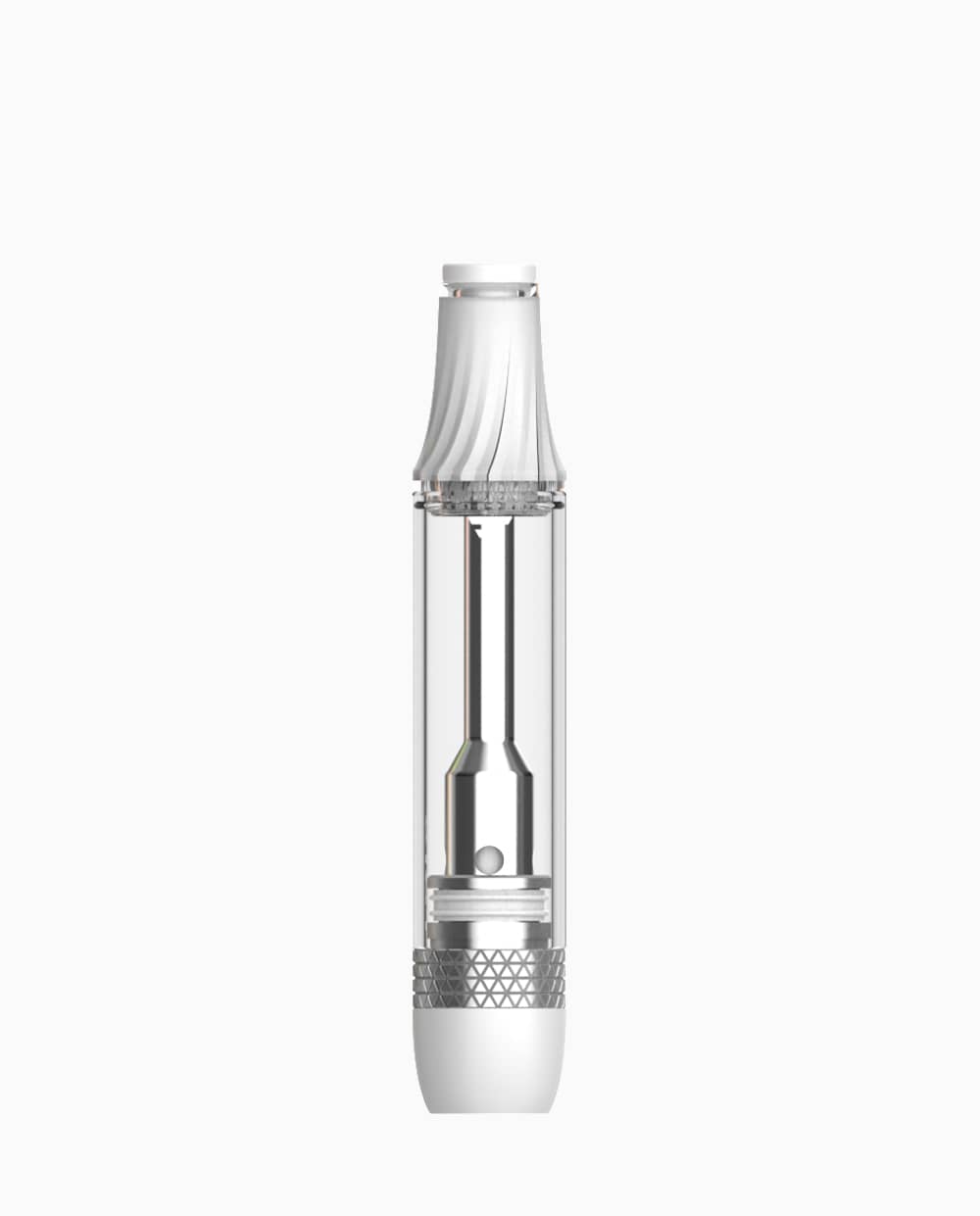
Planar pure ceramic technology typically uses plate-like, sheet-like, or flattened ceramic structures. Unlike cylindrical cotton-wrapped ceramic cores, it does not rely on an outer cotton layer as the primary oil-feeding buffer. Instead, it manages oil delivery, surface wetting, heating, and vaporization through the ceramic body’s pore structure, heating surface design, and oil-path layout.
Its core value is not simply “no cotton.” It is that vaporization performance depends more directly on the ceramic material, structural design, and manufacturing consistency.
This brings several important advantages:
- 1. Cleaner material pathway
Without an outer cotton layer participating in the main oil-feeding process, the product can more clearly communicate technical concepts such as clean vapor path, pure ceramic heating, and no cotton burn.
- 2. Purer flavor expression
For Live Resin, Rosin, Live Rosin, and premium distillates, consumers are not only buying potency or ingredient content. They are also seeking fuller flavor layers and a more stable vaporization experience. Reducing extra oil-absorbing material variables helps improve flavor purity and consistency.
- 3. More room for structural innovation
Planar ceramic is easier to integrate into slim, transparent, technology-driven pod or disposable designs, helping brands build stronger visual identity and a more premium hardware feel.
- 4. Fewer assembly-related variables
Because it does not rely on manually wrapped cotton as the primary oil-supply compensation layer, planar pure ceramic can reduce the impact of cotton tightness, thickness uniformity, and fit deviation on performance.
However, planar pure ceramic is not automatically perfect. It shifts the technical challenge from the outer cotton layer to the ceramic body and the overall structural design. If the ceramic body cannot supply oil effectively, or if the oil cannot consistently cover the heating surface, issues such as localized dry burning, burnt taste, vapor drop-off, or late-stage flavor decay may still occur.
So the real key is not simply whether cotton is used, but whether the ceramic body can consistently complete oil delivery, wetting, and vaporization.
2. Optimizing Heating Area for Rich Vapor and Burn Prevention
Optimizing vaporization performance requires understanding thermal dynamics. A hardware solution must deliver satisfying vapor without exceeding the thermal limits of the extract’s delicate chemical compounds.
2.1 The Physics of Surface Area: Achieving Rich Vapor at Mild Temperatures
Live Resin and Rosin need relatively gentle temperatures to preserve their delicate flavor profiles, but low temperatures often lead to insufficient vapor volume and weak inhalation feedback.
For example, Live Resin performs best within a low-temperature golden range of 180°C to 210°C to capture volatile terpenes without charring, while solventless Rosin requires an even gentler vaporization curve between 160°C and 190°C to avoid burning delicate plant lipids. Research on heated terpenoids in vaporizable cannabis concentrates also shows why temperature control matters for terpene retention and degradation byproducts.
For premium extracts, vaporization cannot simply chase “huge clouds” or “low temperatures” in isolation. If the temperature is too high, terpenes are destroyed, inhalation throat hit becomes harsh, and late-stage burnt flavors appear. If the temperature is too low, the oil is under-vaporized, resulting in weak vapor production and a lack of satisfying feedback for the user.
Therefore, high-end vaporization hardware must achieve stable vapor production at lower, gentler temperatures. A larger effective heating area is designed to address this. Instead of simply raising the temperature, a larger heating area allows more oil to participate in vaporization simultaneously under milder heat. In other words, by expanding the vapor-producing region, it increases overall vapor volume without raising the temperature of any single point, protecting the flavor profile and reducing dry-hit risks.
2.2 The Dual-Coil Trap: Balancing Cloud Output with Leakage and Sealing Risks
Some hardware solutions in the market utilize dual ceramic coils to boost vapor output and inhalation feedback by adding a second heating unit.
While dual ceramics excel at increasing vapor volume, their primary value is vapor quantity rather than flavor purity. Furthermore, dual ceramics mean more oil intake zones, more complex sealing interfaces, and higher power demands. If the sealing design or assembly consistency is insufficient, the risk of leakage increases significantly compared to single ceramic structures. Therefore, for B2B projects that prioritize premium flavor, low leakage rates, and mass-production stability, dual ceramics should not be blindly accepted as “more advanced” but evaluated cautiously through rigorous testing.
3. Materials and Chemistry: Porosity, Sintering, and Purity Standards
When evaluating ceramic cores, B2B brands cannot just look at the geometric structure. The ceramic material’s formulation, chemistry, and manufacturing process dictate the oil conduction speed, storage capacity, thermal properties, flavor output, and batch-to-batch consistency. The performance of a ceramic core depends on five material factors:
1. Porosity: Porosity determines the volume of oil the ceramic can absorb and transmit. If it is too low, thick oils cannot flow fast enough, causing dry hits. If it is too high, thin or high-terpene oils will flow too fast, causing flooding, spitting, or leakage.
2. Pore Size Distribution: The uniformity of the pores is more important than their average size. Inconsistent pore size distribution leads to uneven oil distribution, local dry spots, flavor fluctuations, and batch variation.
3. Thermal Conductivity: The ceramic’s thermal properties affect ramp-up speed and heat dissipation. It must heat up fast enough for immediate feedback but avoid heat retention that chars the oil between draws.
4. Sintering Consistency: Sintering (firing) changes the ceramic’s strength, pore structure, and thermal properties. Inconsistent sintering leads to batch-to-batch differences, where some devices perform well while others leak or dry-hit.
5. Material Purity: Lower-quality ceramics can introduce impurities, off-tastes, heavy metals, or loose particles. Lower-quality ceramics risk introducing chemical impurities or heavy metal contamination (such as Lead, Cadmium, or Arsenic), failing strict regulatory checks. For high-value extracts and medical markets, the ceramic must be chemically pure and certified safe.
4. B2B Selection Matrix: Extract Viscosity vs. Ceramic Architecture
To help B2B brands make informed procurement decisions, the table below highlights the key differences between the two technical paths:
| Comparison Dimension | Cylindrical Cotton-Wrapped Ceramic | Planar Pure Ceramic |
|---|---|---|
| Primary Oil Conduction | Cotton layer + Ceramic body | Ceramic body (no cotton) |
| Material Variables | High (cotton density, thickness, saturation) | Low (pure ceramic material path) |
| Assembly Variables | High (manual wrapping tightness and alignment) | Low (automated ceramic positioning) |
| Flavor Purity | Moderate (subject to cotton absorption & aging) | Excellent (pure ceramic vapor path) |
| Terpene Expression | Moderate (susceptible to localized hotspots) | Excellent (uniform heat distribution) |
| Continuous Draw Performance | High risk of dry hits if oil replenishment lags | Stable (direct ceramic conduction) |
| Late-Stage Flavor Stability | Susceptible to charring and flavor decay | High consistency (minimal carbon buildup) |
| Leakage & Spitting Risk | Higher (if cotton layer becomes oversaturated) | Low (controlled pore structure capillary lock) |
| Best Suited Extract Types | Standard Distillates (low-to-mid viscosity) | Live Resin, Rosin, High-Terpene Extracts |
| Typical B2B Application | Cost-effective, high-volume disposables | Premium cartridges, high-end pod systems |
4.1 Distillate
For standard distillates, cylindrical cotton-wrapped ceramics remain a viable, cost-effective option, particularly for mass-market disposables where cost is a primary constraint. The outer cotton layer provides an oil conduction buffer that helps maintain steady supply for moderate-to-high viscosity distillates in the early-to-mid stages of use.
However, brands positioning their distillates in the premium segment or emphasizing a clean vapor narrative should still evaluate planar pure ceramics. This minimizes material variables and improves late-stage flavor retention.
Key test metrics for distillates:
-
- Dry hit resistance under continuous draws;
-
- Late-stage flavor retention and vapor output;
-
- Spitting or leakage across different temperature storage environments.
4.2 Live Resin
Live Resin puts flavor preservation and temperature stability above raw vapor volume. Cylindrical cotton-wrapped ceramics are not ideal here. The variables of the cotton layer, combined with localized hotspots from helical wires, easily lead to terpene degradation, bitter notes, and color darkening in the oil tank.
For Live Resin, brands should prioritize planar pure ceramics with a balanced heating area. This allows the delicate terpene profiles to vaporize at gentler temperatures, preventing charring and delivering a smooth, clean flavor.
Key test metrics for Live Resin:
-
- Terpene profile retention across the entire lifecycle;
-
- Oil color stability in the tank (checking for oxidation or backflow of charred oil);
-
- Leakage rates under warm conditions (due to high terpene content lowering viscosity).
4.3 Rosin / Live Rosin
Solventless Rosin is the most demanding extract in the market. It contains natural plant waxes, lipids, and highly volatile terpenes, making it highly susceptible to clogging, charring, and dry-firing. Cylindrical cotton-wrapped structures represent a high risk of failure for Rosin.
Rosin requires planar pure ceramics with optimized porosity, precise heating area control, and low-voltage power settings. The hardware must have excellent preheating capabilities and a postless (no center post) design to prevent clogging and oil waste.
Key test metrics for Rosin:
-
- Clogging resistance (especially after periods of inactivity);
-
- Residue and flavor purity in the final 10% of the tank;
-
- Preheating efficiency at low battery voltages.
4.4 Large-Capacity Disposables (2g – 5g+)
For large-capacity hardware, the challenge is full-cycle stability. A device that tastes great for the first 100 puffs but degrades by puff 500 is a failure that will lead to high RMA rates and negative brand reviews.
Large-capacity devices must utilize planar pure ceramics with a wide, uniform heating area to minimize localized carbon buildup. The oil conduction rate must remain stable as the oil volume and head pressure decrease. The battery output must also be regulated to prevent voltage drops from weakening vapor production in the late stages.
Key test metrics for large-capacity disposables:
-
- Flavor consistency comparison between the first 10% and the final 10% of oil;
-
- Clogging and leakage rates after multiple heating cycles;
-
- Battery life matching oil volume (ensuring the battery doesn’t die before the oil is fully consumed).
5. Hardware Validation: The B2B QC and Adaptation Testing Checklist
To minimize supply chain risks and ensure product safety, B2B brands should not rely solely on supplier specifications. They should conduct a rigorous validation process using the following checklist:
-
- Real Extract Compatibility Testing: Do not rely on generic test oils. Use your own proprietary extract formulations to test oil flow, vapor thickness, and flavor representation. Different terpene cuts and viscosities behave differently under heat.
-
- Full-Cycle Draw Analysis: Test the device through its entire volume. Monitor flavor degradation, color change, clogging, and vapor volume in the initial stage, middle stage, and the final 10% of oil. Ensure there is minimal oil left unconsumed (low residue).
-
- Stress Draw Testing: Simulate heavy users by conducting continuous draw tests (e.g., 5-second draws every 10 seconds). Check for dry hits, burnt taste, airflow restriction, and battery overheating.
-
- Leakage and Environmental Stability Tests: Expose the filled devices to temperature and pressure variations. Conduct high-temperature storage (40°C), low-temperature storage (0°C), horizontal/upside-down storage, and pressure changes to check for leakage, spitting, or clogging.
-
- Batch-to-Batch Consistency Verification: Compare performance across different production batches. Check if draw resistance (resistance to draw), vapor output, and flavor profile remain consistent. For regulated cannabis markets, align product validation with COA and laboratory testing expectations. Look for outliers that exhibit premature failure.
-
- Supplier Technical Support and RMA Collaboration: Ensure the supplier can provide technical analysis, forensic teardowns of failed units, and provide recommendations based on your oil type to match your specific oil characteristics.
6. Conclusion: Choosing a Ceramic Core is Choosing an Oil Adaptation Solution
The ceramic core in a cannabis vaporizer should not be viewed as an isolated material component. It dictates how the oil is drawn, heated, and vaporized, directly determining whether the consumer experiences a pure, smooth, and consistent flavor, or is frustrated by dry hits, clogs, leaks, and flavor decay.
Cylindrical cotton-wrapped ceramics served their purpose for standard distillates, but they present significant limitations for Live Resin and Rosin due to material variables, assembly tolerances, and localized hotspots.
Planar pure ceramics represent the future for premium extracts, eliminating cotton variables and utilizing the ceramic body itself for uniform heating and clean vapor delivery. When combined with a larger effective heating area, they allow low-temperature vaporization that preserves delicate terpenes while maintaining satisfying vapor production.
For B2B brands, the key is to choose a hardware partner that provides a complete, tested vaporizer hardware solution—one backed by material expertise, customized engineering, and rigorous quality control—rather than just a product catalog.
FAQ: Common Questions on Ceramic Vaporizer Cores
1. Are cylindrical cotton-wrapped ceramics obsolete?
Not entirely. They are still highly effective for standard distillates and value-focused, high-volume disposable projects where cost-efficiency is paramount. However, they are not recommended for premium Live Resin or Rosin extracts due to flavor degradation and assembly variables.
2. Why do cylindrical structures cause localized hotspots?
They rely on helical wires wrapped around or co-fired inside a ceramic cylinder. Spacing tolerances, wrapping tightness, and material density variations can cause heat to concentrate in specific spots, leading to local overheating, terpene destruction, and charring.
3. Is planar pure ceramic always better?
Not necessarily. Planar pure ceramic excels in flavor purity, material safety, and consistency. However, it demands precise matching of ceramic porosity, heating surface coverage, and power delivery to the oil’s viscosity. Poorly engineered pure ceramics can still leak or dry-hit.
4. What is the benefit of a larger effective heating area?
It reduces the thermal load per unit area. By spreading the heat over a wider surface, it allows more oil to vaporize at a lower, gentler temperature, producing satisfying vapor without destroying delicate terpene profiles.
5. Can the heating area be too large?
Yes. If the heating area is too large but the ceramic’s oil conduction cannot cover it evenly, “dry zones” will form, causing immediate dry hits. The power output and airflow must also be calibrated to match the area.
6. What ceramic core is best for Live Resin?
Live Resin is best paired with planar pure ceramics. Focus on options that offer uniform heating and moderate-to-low power settings to preserve volatile terpenes and prevent color changes in the tank.
7. What ceramic core is best for Rosin / Live Rosin?
Rosin requires planar pure ceramics with high porosity for oil flow, low-voltage heating curves to avoid burning plant lipids, and postless hardware structures to prevent clogging and residue accumulation.
8. Are dual ceramic coils a premium upgrade?
Not automatically. While they increase vapor volume, they consume more battery, require higher power, and have more sealing joints, which can increase leakage risks. They should be evaluated based on B2B target market priorities.
9. How should B2B brands perform quality control on ceramic cores?
Perform lifecycle draw tests using your exact oil formulation, check for flavor consistency through the last 10% of oil, conduct high/low-temperature leak tests, and verify draw resistance and vapor consistency across multiple production batches.